Close Menu
Money MechanicsMoney Mechanics
    What's Hot

    Nasdaq Falls 579 Points on Global AI Bubble Fear: Stock Market Today

    June 23, 2026

    Everything borrowers are asking about the overhaul

    June 23, 2026

    UAE’s exit from OPEC+ reduced the group’s share of crude oil production and capacity

    June 23, 2026
    Facebook X (Twitter) Instagram
    Trending
    • Nasdaq Falls 579 Points on Global AI Bubble Fear: Stock Market Today
    • Everything borrowers are asking about the overhaul
    • UAE’s exit from OPEC+ reduced the group’s share of crude oil production and capacity
    • This Spring’s Most Competitive Housing Markets
    • The best Prime Day Samsung deals: Save big on Galaxy phones, tablets, and more
    • CanCambria Energy to Host Investor Update Webcast on Kiskunhalas Project and Recent Strategic Developments
    • Global Tech Selloff Underway, Hitting Broader Market as Well
    • Trump Baby Wealth Accounts And The $300,000 Newborn Gap
    Facebook X (Twitter) Instagram
    Money MechanicsMoney Mechanics
    • Home
    • Markets
      • Stocks
      • Crypto
      • Bonds
      • Commodities
    • Economy
      • Fed & Rates
      • Housing & Jobs
      • Inflation
    • Earnings
      • Banks
      • Energy
      • Healthcare
      • IPOs
      • Tech
    • Investing
      • ETFs
      • Long-Term
      • Options
    • Finance
      • Budgeting
      • Credit & Debt
      • Real Estate
      • Retirement
      • Taxes
    • Opinion
    • Guides
    • Tools
    • Resources
    Money MechanicsMoney Mechanics
    Home»Earnings & Companie»Energy»UAE’s exit from OPEC+ reduced the group’s share of crude oil production and capacity
    Energy

    UAE’s exit from OPEC+ reduced the group’s share of crude oil production and capacity

    Money MechanicsBy Money MechanicsJune 23, 2026No Comments3 Mins Read
    Facebook Twitter LinkedIn Telegram Pinterest Tumblr Reddit WhatsApp Email
    UAE’s exit from OPEC+ reduced the group’s share of crude oil production and capacity
    Share
    Facebook Twitter LinkedIn Pinterest Email


    In-brief analysis

    June 23, 2026
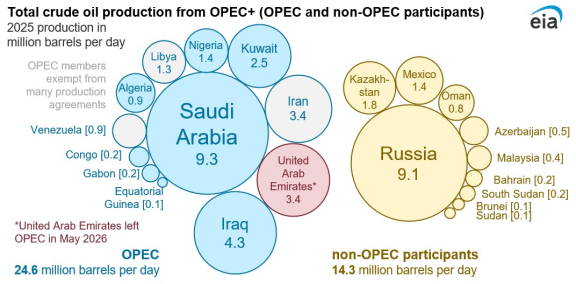


    Total crude oil production from OPEC+ (OPEC and non-OPEC participants)


    On April 28, 2026, the United Arab Emirates (UAE) announced that it was leaving OPEC, effective on May 1. OPEC was formed in 1960 by Iraq, Iran, Kuwait, Saudi Arabia, and Venezuela, with the stated objective to “coordinate and unify petroleum policies among Member Countries.” OPEC is best known for its effect on global crude oil prices.

    The UAE joined OPEC as the emirate of Abu Dhabi in 1967 and as of 2025 held the third-largest crude oil production capacity in the group behind Saudi Arabia and Iraq. The UAE produced an average of 3.4 million b/d of crude oil and held an estimated 4.2 million b/d of effective production capacity in 2025. This was all before the onset of the conflict in Iran on February 28, 2026 and the effective closure of the Strait of Hormuz, which has lowered production levels in the region and significantly impacted oil markets.

    OPEC (including the UAE) produced an estimated 28.0 million b/d of crude oil in 2025, 35% of total world crude oil production that year. Without the UAE’s contribution, the group’s share of world total crude oil production would have been 31% in 2025. The largest producer and most influential member of OPEC is Saudi Arabia, which was the world’s second-largest oil producer in 2025 (9.3 million b/d), after the United States, and held an estimated 11.6 million b/d of effective production capacity in 2025.

    The larger OPEC+ group (also known as the Declaration of Cooperation) was formed in 2016 largely in response to dramatically falling oil prices driven by significant increases in U.S. shale oil output. OPEC+ meetings and coordinated production targets still influence global oil prices, and market participants closely follow them. Beginning in April 2023, several OPEC+ producers agreed to numerous rounds of voluntary cuts to crude oil production “aimed at supporting the stability of the oil market.” The UAE and Saudi Arabia made among the largest voluntary cuts to crude oil production as part of those agreements, at a time when the UAE’s production capacity increased.

    Production from OPEC+ countries made up about 46% of global crude oil production in 2025; without the UAE, the OPEC+ portion would have been closer to 42%. More recent production agreements have exempted Iran, Venezuela, and Libya.

    Since the closure of the Strait of Hormuz, the UAE and Saudi Arabia were the only regional OPEC countries able to reroute crude oil exports around the Strait of Hormuz. The UAE redirected oil exports via the Abu Dhabi Crude Oil Pipeline (ADCOP) to the port of Fujairah in the Gulf of Oman just outside of the Strait. The pipeline currently has a maximum capacity of 1.8 million b/d, and the UAE recently announced that it intends to double the pipeline’s capacity by 2027. Similarly, Saudi Arabia rerouted crude oil exports to the Red Sea via its 7 million-b/d East-West pipeline to the port of Yanbu on the Red Sea, with 5 million b/d of that capacity available for exports and the rest for domestic consumption.

    Due to these investments, Saudi Arabia and the UAE have seen lower relative volumes of shut-in crude oil production compared with other Middle Eastern producers reliant on the Strait of Hormuz to reach global oil markets.
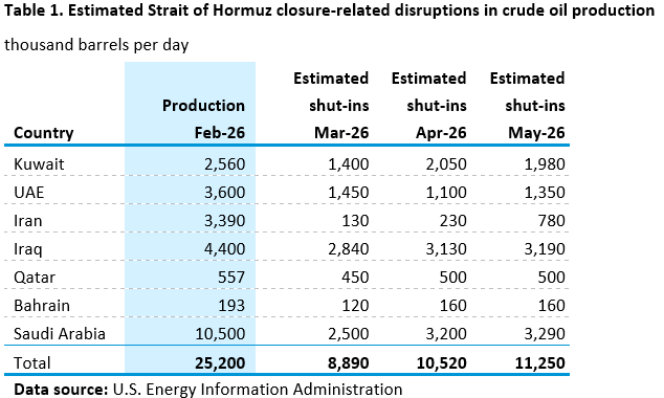
    Estimated Strait of Hormuz closure-related disruptions in crude oil production


    While OPEC+ meetings continue to focus on setting crude oil production targets based on their assessments of global oil balances, the de facto closure of the Strait of Hormuz limited their ability to increase production levels.

    Principal contributor: Sean Hill


    Source link

    Share. Facebook Twitter Pinterest LinkedIn Tumblr Telegram Email
    Previous ArticleThis Spring’s Most Competitive Housing Markets
    Next Article Everything borrowers are asking about the overhaul
    Money Mechanics
    • Website

    Related Posts

    CanCambria Energy to Host Investor Update Webcast on Kiskunhalas Project and Recent Strategic Developments

    June 23, 2026

    America’s second oil boom – Oil & Gas 360

    June 23, 2026

    Devon Energy’s latest reinvention reflects a familiar corporate pattern

    June 22, 2026
    Add A Comment
    Leave A Reply Cancel Reply

    Top Posts

    Nasdaq Falls 579 Points on Global AI Bubble Fear: Stock Market Today

    June 23, 2026

    Everything borrowers are asking about the overhaul

    June 23, 2026

    UAE’s exit from OPEC+ reduced the group’s share of crude oil production and capacity

    June 23, 2026

    This Spring’s Most Competitive Housing Markets

    June 23, 2026

    Subscribe to Updates

    Please enable JavaScript in your browser to complete this form.
    Loading

    At Money Mechanics, we believe money shouldn’t be confusing. It should be empowering. Whether you’re buried in debt, cautious about investing, or simply overwhelmed by financial jargon—we’re here to guide you every step of the way.

    Facebook X (Twitter) Instagram Pinterest YouTube
    Links
    • About Us
    • Contact Us
    • Disclaimer
    • Privacy Policy
    • Terms and Conditions
    Resources
    • Breaking News
    • Economy & Policy
    • Finance Tools
    • Fintech & Apps
    • Guides & How-To
    Get Informed

    Subscribe to Updates

    Please enable JavaScript in your browser to complete this form.
    Loading
    Copyright© 2025 TheMoneyMechanics All Rights Reserved.
    • Breaking News
    • Economy & Policy
    • Finance Tools
    • Fintech & Apps
    • Guides & How-To

    Type above and press Enter to search. Press Esc to cancel.