


With capacity constraints likely to limit the insurance industry’s ability to fully insure hyperscale data centre projects, given their scale and complexity, a new report from S&P notes that this will drive greater use of self-insurance through captive insurers, and potentially, alternative capital such as insurance-linked securities (ILS).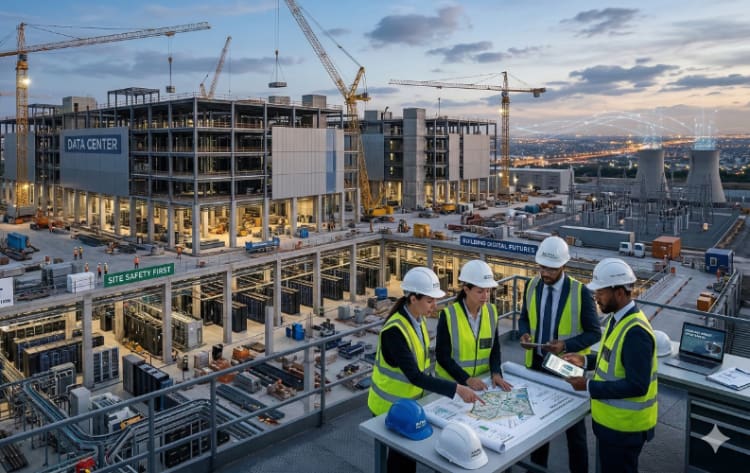
At the same time, S&P also indicated that annual investment in data centres could surpass $300 billion by 2027, highlighting the industry’s explosive growth and the growing insurance requirements associated with large-scale infrastructure development.
For background, S&P pointed out that insurance coverage limits of $5 billion to $10 billion are usually needed for the biggest infrastructure construction projects, like bridges or tunnels. By comparison, some hyperscale data centers are estimated to represent total insurable values of $10 billion to $30 billion for construction alone.
As well as this, S&P also outlined that insurers’ exposure to data centres may extend far beyond construction value. In addition to physical structures, assets such as IT equipment and related infrastructure can represent a material portion of total insurable value.
“Insurers may also cover many other risks beyond those involving the physical assets. Risks such as business interruption–due to system downtime, power dependency, and operational disruption–can be equally, if not more, material than the risks involving the physical assets, further expanding insurers’ opportunities and challenges,” S&P commented.
Later in the report, S&P importantly highlighted how capacity constraints will likely limit the industry’s ability to fully insure hyperscale data centre projects, given their scale and complexity. However, this is where the industry is likely to turn towards the capital markets.
“We expect capacity constraints to limit the insurance industry’s ability to fully insure hyperscale data center projects as total insurable values reach $20 billion-$30 billion per location. As a result, some material risks–especially those that arise during the operational phase, such as business interruption and technology-related losses involving IT equipment, for example–will likely remain self-insured or only partially insured,” the agency said.
Adding: “This will drive greater use of self-insurance through captive insurers, and potentially, alternative capital such as insurance-linked securities.”
The agency also noted that the market is increasingly relying on collaborative structures arranged by a particular insurer or insurance broker, in which multiple insurers and reinsurers partner to share risk.
These arrangements not only help bridge the gap between available capacity and growing demand but also support more standardised and efficient insurance of complex risks with multiple stakeholders.
“As the development of hyperscale data centers accelerates, we expect these collaborative structures to play an increasingly central role in scaling up the insurance market’s response. Furthermore, we expect alternative capital to start providing capacity as the market develops,” S&P added.
Read other Artemis articles about the data centre risk transfer opportunity for ILS here.

