


Real gross domestic product (GDP) increased at an annual rate of 2.0 percent in the first quarter of 2026 (January, February, and March), according to the advance estimate released today by the U.S. Bureau of Economic Analysis. In the fourth quarter of 2025, real GDP increased 0.5 percent.
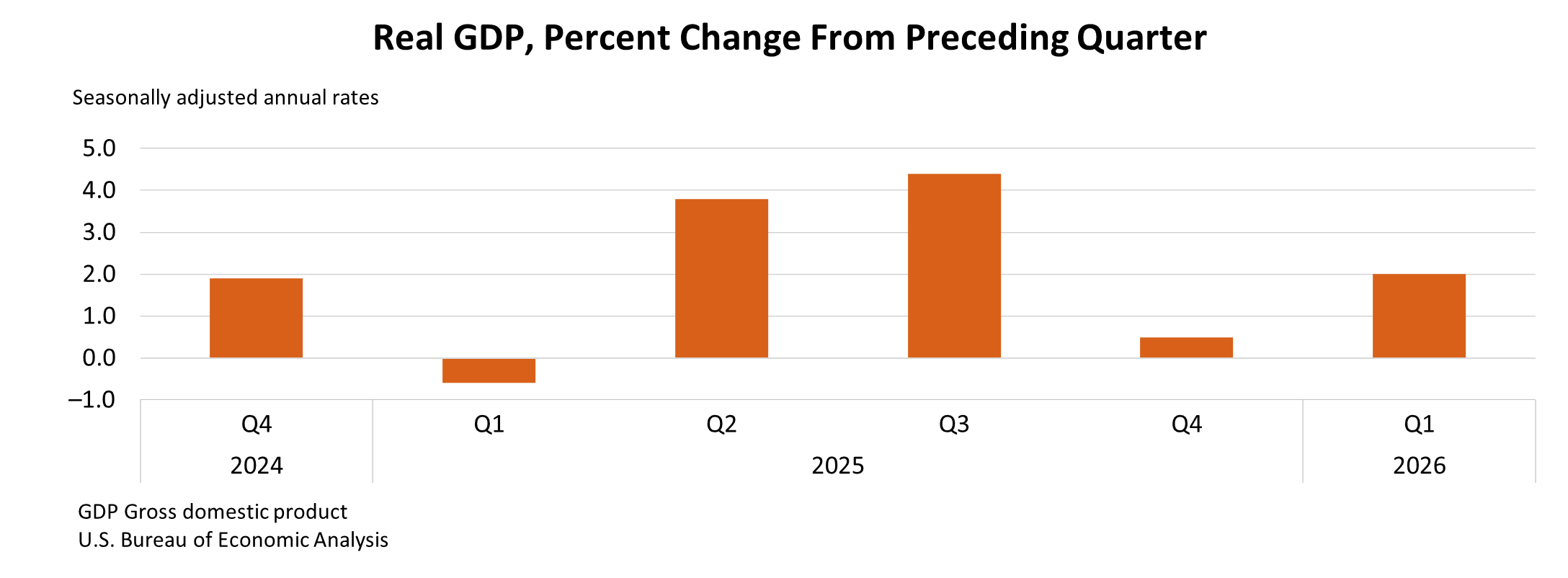
The contributors to the increase in real GDP in the first quarter were investment, exports, consumer spending, and government spending. Imports, which are a subtraction in the calculation of GDP, also increased. For more information, refer to the “Technical Notes” below.
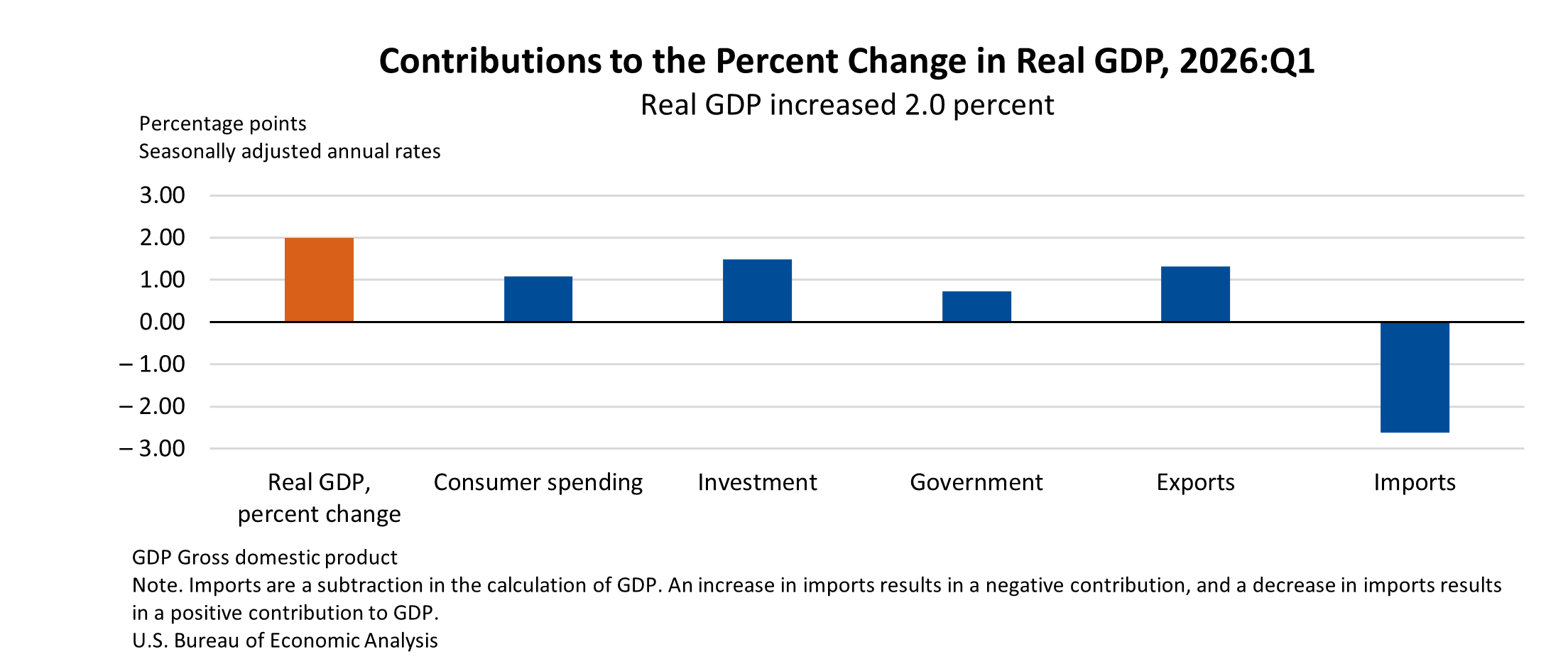
Compared to the fourth quarter of 2025, the acceleration in real GDP in the first quarter of 2026 reflected upturns in government spending and exports, and an acceleration in investment that were partly offset by a deceleration in consumer spending. Imports turned up.
Real final sales to private domestic purchasers, the sum of consumer spending and gross private fixed investment, increased 2.5 percent in the first quarter, compared with an increase of 1.8 percent in the fourth quarter.
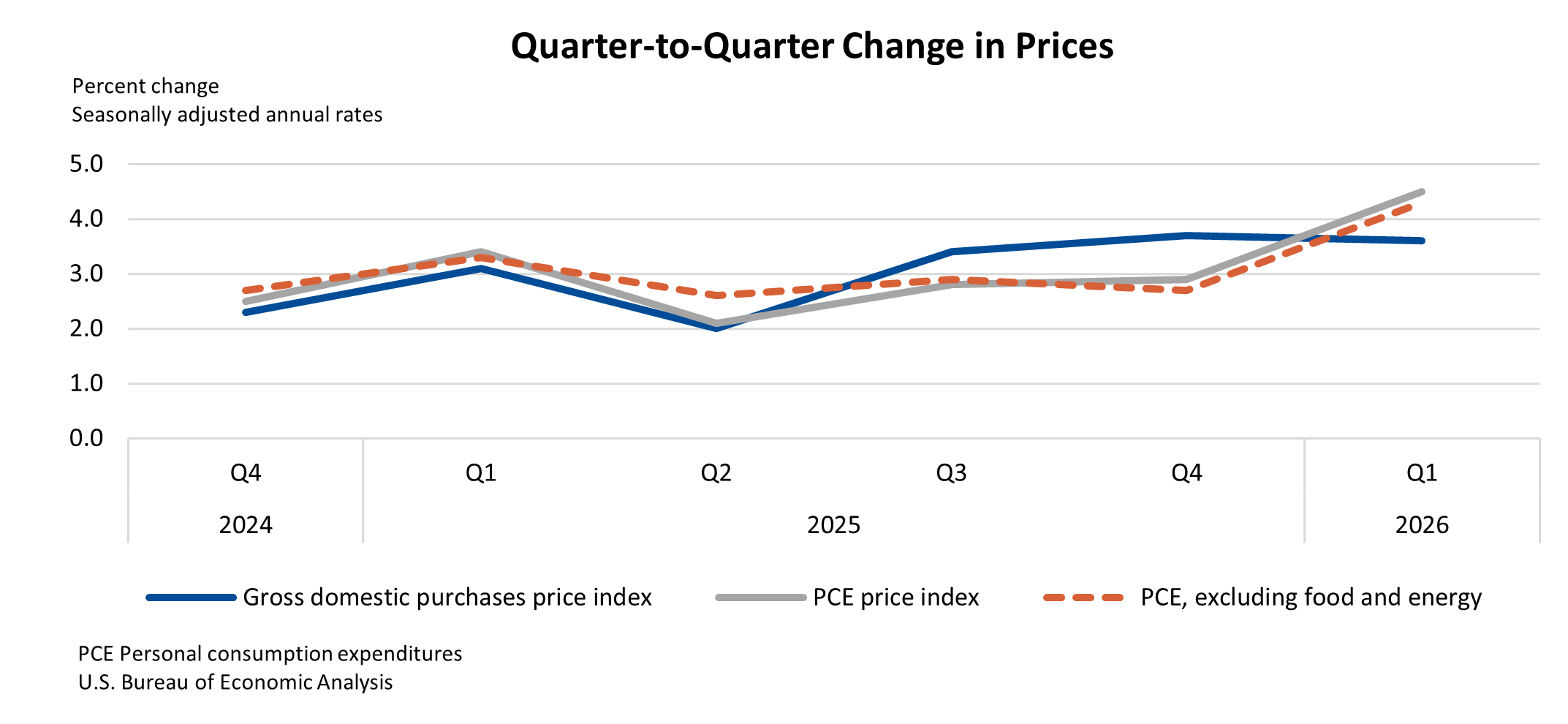
The price index for gross domestic purchases increased 3.6 percent in the first quarter, compared with an increase of 3.7 percent in the fourth quarter. The personal consumption expenditures (PCE) price index increased 4.5 percent, compared with an increase of 2.9 percent, and the PCE price index excluding food and energy increased 4.3 percent, compared with an increase of 2.7 percent.
| Real GDP and Related Measures [Percent change (SAAR) from 2025:Q4 to 2026:Q1] |
|
|---|---|
| Advance Estimate | |
| Real GDP | 2.0 |
| Current-dollar GDP | 5.6 |
| Real final sales to private domestic purchasers | 2.5 |
| Gross domestic purchases price index | 3.6 |
| PCE price index | 4.5 |
| PCE price index excluding food and energy | 4.3 |
Next release: May 28, 2026, at 8:30 a.m. EDT
GDP (Second Estimate) and Corporate Profits, 1st Quarter 2026
Technical Notes
Sources of change for real GDP
Real GDP increased at an annual rate of 2.0 percent (0.5 percent at a quarterly rate1) in the first quarter, reflecting increases in investment, exports, consumer spending, and government spending. Imports, which are a subtraction in the calculation of GDP, increased.
More information on the source data and BEA assumptions that underlie the first-quarter estimate is shown in the key source data and assumptions table.
- The increase in investment reflected increases in equipment, intellectual property products, and private inventory investment that were partly offset by decreases in residential and nonresidential structures.
- Within equipment, the increase primarily reflected an increase in information processing equipment (notably, computers and peripheral equipment), based on data for imports from the Census Bureau-BEA U.S. International Trade in Goods and Services report and the Census Advance Economic Indicators Report for March.
- The increase in intellectual property products primarily reflected an increase in software, based on a judgmental trend.
- Within private inventory investment, the increase primarily reflected increases in retail and wholesale trade, based primarily on Census Bureau inventory book value data.
- The decrease in residential structures was led by new single-family units and brokers’ commissions. Single-family units decreased, reflecting Census Bureau Value-Put-In-Place (VPIP) data for January and Census Bureau housing starts for February and March. Brokers’ commissions decreased, primarily reflecting data on sales of existing and new homes.
- The decrease in nonresidential structures was led by manufacturing structures, based on Census Bureau VPIP data for January, a Dodge Construction Network estimate for February, and a BEA projection for March.
- Exports and imports primarily reflected Census Bureau-BEA U.S. International Trade in Goods and Services data, as well as the Census Advance Economic Indicators Report for March. The increase in both exports and imports primarily reflected an increase in goods (led by computers, peripherals, and parts).
- The increase in goods exports also reflected an increase in industrial supplies and materials. Within exports of industrial supplies and materials in the National Economic Accounts (NEAs), BEA identified and removed an increase in exports of silver bars used as a form of investment in the first quarter. Similar to nonmonetary gold, silver can be used for two purposes: for industrial use (as an input into the production of goods and services) and for investment (as a store of wealth and a hedge against inflation). BEA’s NEAs do not treat transactions in valuables, such as nonmonetary gold and silver, as investments; therefore, purchases of precious metals used as a form of investment are not included in consumer spending, gross private domestic investment, or government spending. For more information, refer to the FAQ, “How are exports and imports of nonmonetary gold treated in BEA’s National Economic Accounts?”.
- The increase in consumer spending primarily reflected an increase in services, led by health care. Within health care, both hospital and nursing home services as well as outpatient services increased, based primarily on Bureau of Labor Statistics Current Employment Statistics.
- The increase in government spending was led by an increase in federal government nondefense spending, mainly federal employee compensation, which increased after decreasing in the fourth quarter of 2025. The pattern of spending was impacted by the government shutdown that occurred in the fourth quarter. For more information, refer to the FAQ, “How are federal government shutdowns reflected in the methodologies used for estimating GDP?”.
Legal services prices
The PCE price index for legal services was adjusted for the months of January and March. No adjustment was made for February. For more information on why BEA sometimes adjusts source data, refer to the FAQ “Does BEA adjust source data that are used to estimate GDP and related measures?”.
International Emergency Economic Powers Act tariff refunds
In February 2026, the Supreme Court of the United States determined that certain tariffs imposed under the International Emergency Economic Powers Act (IEEPA) were unlawful, and it obligated the federal government to refund affected businesses. The refunds are treated as a capital transfer and do not affect first-quarter GDP. For more information, refer to the FAQ “How are the International Emergency Economic Powers Act tariff refunds reflected in BEA’s National Economic Accounts?”.
Related Data Tables
For the estimates highlighted in this release, as well as historical time series for these estimates, see the following data tables in BEA’s Interactive Data Application.
National GDP and related measures
Table 1.1.1. Percent Change From Preceding Period in Real Gross Domestic Product
Table 1.5.2. Contributions to Percent Change in Real Gross Domestic Product, Expanded Detail
Table 1.4.1. Percent Change From Preceding Period in Real Gross Domestic Product, Real Gross Domestic Purchases, and Real Final Sales to Domestic Purchasers
Table 1.6.7. Percent Change From Preceding Period in Prices for Gross Domestic Purchases
Note. With the next release of GDP, today’s data will be superseded, and the links above will reflect the latest data. The original data featured in this release can then be accessed in BEA’s Data Archive.
