



- 53% of U.S. residents oppose building a data center in their area, while 34% support it, per a recent Redfin survey.
- U.S. residents are more likely to oppose data centers in their neighborhood than any other type of building; for instance, 39% oppose a new apartment complex nearby.
- AI data centers are controversial because they strain electricity and water resources, and can disrupt communities with noise and large structures.
- But a Redfin analysis found that AI data centers have benefits: In northern Virginia, taxes on data center equipment are likely contributing to a surge in education spending. Meanwhile, individual homeowners’ property-tax rates are declining.
- Data center hubs Loudoun County, VA and Prince William County, VA have seen education spending nearly double over the last decade.
More than half (53%) of U.S. residents oppose the construction of an AI data center in their neighborhood, according to a recent Redfin survey. Roughly one-third (34%) support it.
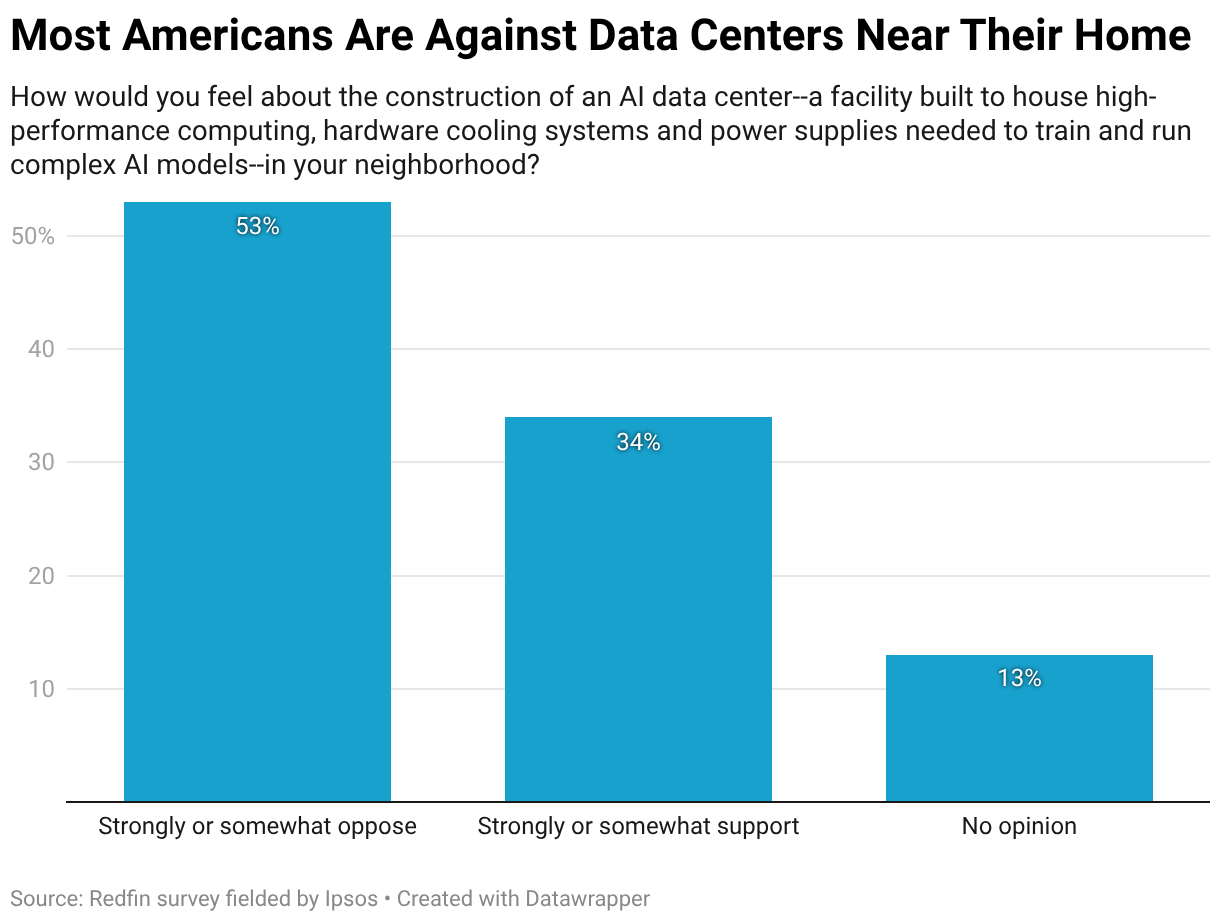
This is according to a Redfin-commissioned survey conducted by Ipsos in May 2026, fielded to 4,000 U.S. residents. The results for this combined group of survey respondents have a credibility interval of +/-1.9 percentage points. This report focuses on a question about how respondents feel about building certain types of properties in their neighborhoods. The building types are listed in the chart in the final section of this report. Respondents could select “strongly support,” “somewhat support,” “strongly oppose,” “somewhat oppose,” or “no opinion.” For this report, we combined the strongly/somewhat responses.
AI data centers are controversial largely because they strain electricity and water resources, which can push up energy costs and spark environmental concerns, per various news sources. They can also disrupt communities with noise and large, industrial-looking structures. One example of opposition is New York’s recent statewide ban on building large data centers. For some people, AI data centers also represent broader fears about AI: Nearly three in five (58%) of U.S. residents believe that advances in AI will eliminate jobs and make it harder to afford homes, according to the same survey.
“A buyer recently asked me, unprompted, to make sure there wasn’t a data center planned near a home she was considering,” said Matt Ferris, a Redfin Premier agent in northern Virginia. “I have another client who recently moved into a community in Gainesville, in Prince William County, where there are several data centers. About a year after they moved in, they said they probably would have chosen a different location had they known there were so many data centers nearby. People are concerned about noise, increased traffic, heavy water and electricity use, and how a large industrial building might change the feel of their neighborhood. Right or wrong, the perception is that data centers will change neighborhoods in a negative way.”
Broken down by age, older generations are more likely than younger generations to oppose data centers in their area. Roughly two-thirds (65%) of baby boomers and 60% of Gen Xers oppose the construction of an AI data center in their neighborhood, compared with 42% of Gen Zers and 43% of millennials.
Additionally, Americans are more likely to oppose data centers in their neighborhood than any other type of building we asked about. More than half of U.S. residents oppose construction of a data center near their home, while 39% oppose a new apartment complex and 32% oppose a mixed-use development. Forty-eight percent oppose converting single-family homes into smaller dwellings to increase supply in their area.
AI Data Centers Are Helping Fund Virginia Schools
While the majority of Americans don’t want to live near AI data centers, the structures can provide educational benefits to communities.
The boom in AI data centers in northern Virginia is helping fund public schools through a surge in tax revenue. A Redfin analysis of county financial records found that Virginia’s two largest data-center hubs—Loudoun County and Prince William County—have seen far faster growth in education spending than neighboring counties over the last 15 years. Both counties collect substantial taxes on computer equipment housed inside data centers; Loudoun’s financial reports identify computer equipment in data centers as the largest source of personal property tax revenue, which is paid by the companies responsible for them.
Loudoun County is home to 176 data centers, more than twice the number of any other U.S. county. Neighboring Prince William County ranks third nationally, with 77 facilities. Santa Clara County, CA is second, with 83 data centers; we didn’t include Santa Clara County in this analysis of education spending because data centers aren’t a major source of revenue for that area.
This analysis found that AI data centers are driving a tax windfall in Loudoun and Prince William counties. Personal property tax revenue, which are levies imposed on physical assets—like AI data centers—per resident has increased nearly 639% in Loudoun County over the last 15 years, and it rose 349% in Prince William County. That’s compared with 91% growth in neighboring Fairfax County, which has the fifth-most data centers in the U.S. but far fewer than Prince William County or Loudon County.
Increased tax revenue from data centers has contributed to a surge in education spending in Prince William and Loudoun counties. Prince William County increased education spending per resident by 82% to $1,589 over the last 15 years. Loudoun County increased it by 77% to $2,955 per resident. For comparison, Fairfax County increased education spending per resident by 49% to $2,234 over that period. Stafford County, VA, where there is just one operational data center, increased it by 29% to $1,024.
| Impact of AI Data Centers on Education Spending
Select Northern Virginia counties |
||||
| Loudoun County, VA | Prince William County, VA | Fairfax County, VA | Stafford County, VA | |
| Number of data centers | 176
(most in the U.S.) |
77
(third-most in the U.S.) |
45
(fifth-most in the U.S.) |
1 |
| Increase in personal property tax revenue, 2010-2025 | 639% | 349% | 91% | |
| Increase in education spending per resident, 2010-2025 | 77% | 82% | 49% | 29% |
| Education spending per resident, 2025 | $2,955 | $1,589 | $2,234 | $1,024 |
Local officials from Loudoun County have linked revenue from AI data centers to school funding. The county website says, “Over the past decade, revenue growth from data centers has allowed the county to address increasing service needs for Loudoun County Public Schools and to fund improved services to our residents while consistently lowering the real property tax rate.”
Average teacher salaries have risen more rapidly in Loudoun County than in neighboring Fairfax County, which has far fewer data centers. Teacher salaries in Loudoun County rose roughly 40% to about $83,000 from 2010 to 2023; that’s compared with a 29% increase to about $82,000 in Fairfax County. Still, teacher pay in Virginia is lagging behind the U.S. as a whole.
Virginia recently approved a new statewide tax on data center power consumption, which would go to the state’s general fund.
Virginia’s Data Center-Heavy Counties Are Collecting More Tax Revenue While Cutting Homeowner Rates
Loudoun and Prince William counties are seeing more revenue growth from personal property taxes than counties with fewer or no data centers.
Meanwhile, the property-tax rate for individual homeowners has steadily fallen over the past decade.
“Loudoun County’s expanding data-center tax base has given local officials more capacity to invest in schools, including higher education spending and teacher compensation, without upping tax rates on homeowners,” said Redfin Economist Yingqi Xu. “Because data centers are taxed largely through personal property taxes on computer equipment, that revenue can help fund growing budgets without putting the same pressure on residential real estate taxes. Surging data-center revenue allows counties to rely less heavily on homeowners to fund education, though it’s important to note that a surge in data-center revenue doesn’t automatically translate dollar-for-dollar to public spending.”
Prince William County cut its real-property tax rate from $1.12 per $100 of assessed value in 2022 to $0.92 in 2025. Due to that decline, the county has kept its estimated residential tax levy relatively flat at roughly $1,320 per resident since 2023.
Loudoun County cut its real-property tax rate from 0.89% in 2022 to 0.81% in 2025. But rising home values have offset those rate cuts: Redfin estimates that the county’s residential property-tax levy per resident increased from roughly $1,574 in 2014 to about $2,005 in 2024 before leveling off in 2025.
Matt Ferris, the Redfin agent in northern Virginia, says homebuyers and sellers aren’t concerned about tax revenue going toward education spending. “Prince William, Loudoun, Fairfax, and other counties in this area already have pretty well-funded schools. Residents are more worried about quality of life than a little extra money in county coffers,” he said.
Here’s a video featuring Matt Ferris and Redfin Chief Economist Daryl Fairweather:
Methodology
Much of this report is based on a Redfin analysis of county Annual Comprehensive Financial Reports (ACFRs) for select Virginia and Maryland counties—covering fiscal years 2010 through 2025. From each county’s ACFR we collected real and personal property tax revenue, education spending, residential assessed value, and real property and computer-equipment (data center) tax rates, and combined these with U.S. Census Bureau population estimates to calculate per-resident figures and growth rates. Per-capita measures divide each metric by county population; the estimated residential tax levy is calculated as residential assessed value multiplied by the real property tax rate. Data-center counts by county are from a Business Insider compilation of U.S. data-center locations (2025).
The survey results in this report are from a survey commissioned by Rocket Mortgage and Redfin, and conducted by Ipsos, in May 2026. It was fielded to a nationally representative sample of 4,000 adults 18+ who are U.S. residents. The results for this combined group of survey respondents have a credibility interval of +/-1.9 percentage points. This report focuses on a question about how respondents feel about building certain types of properties in their neighborhoods. The building types are listed in the chart in the final section of this report. Respondents could select “strongly support,” “somewhat support,” “strongly oppose,” “somewhat oppose,” or “no opinion.” For this report, we combined the strongly/somewhat responses.
