


In-brief analysis
July 22, 2026
Data source: U.S. Energy Information Administration, Weekly Petroleum Status Report
Note: Commercial crude oil inventories do not include crude oil in the Strategic Petroleum Reserve (SPR).
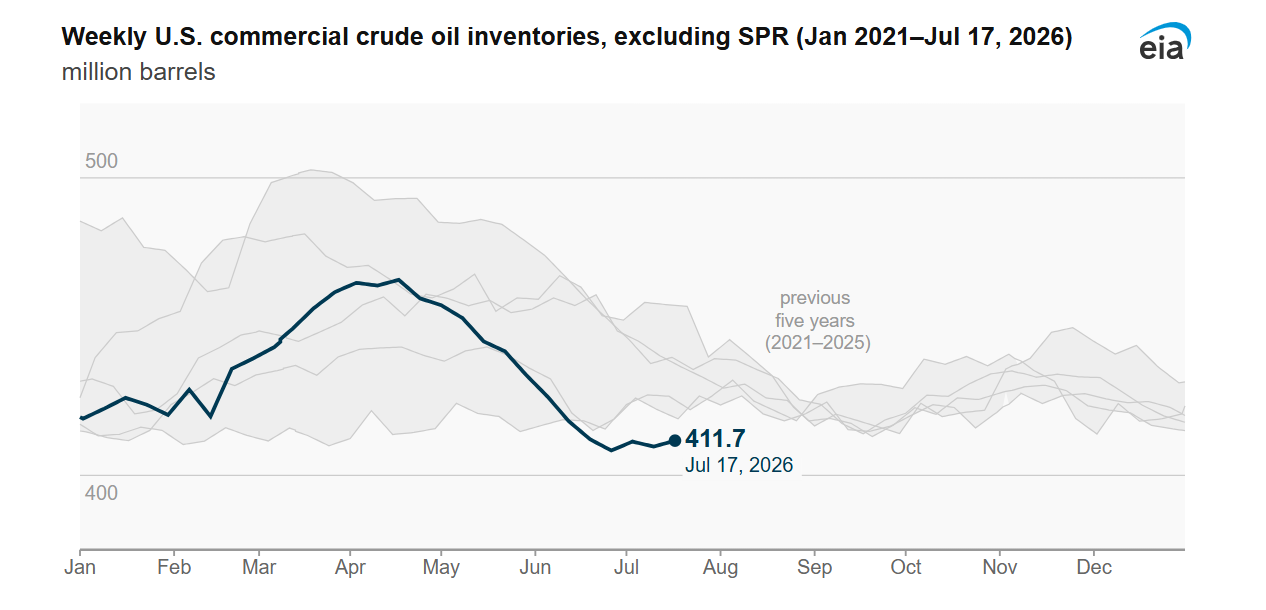
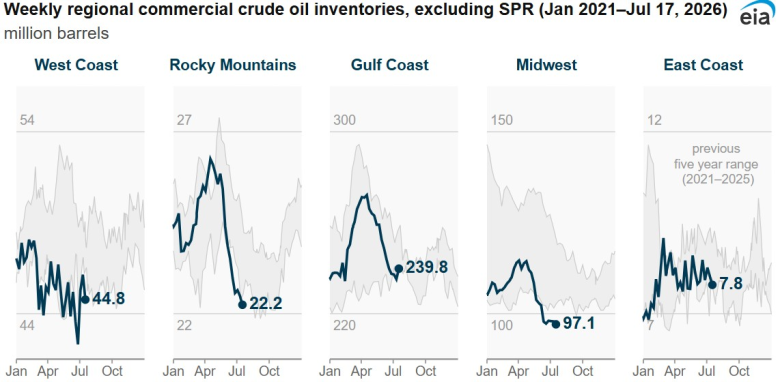
For the week ending July 17, 2026, commercial crude oil inventories (excluding the Strategic Petroleum Reserve) increased 2.0 million barrels to 411.7 million barrels, 6% below the previous five-year (2021–2025) average. Gasoline inventories increased 0.8 million barrels, 7% below the five-year average. Distillate inventories increased 1.4 million barrels, 10% below the five-year average. Propane/propylene inventories increased 6.3 million barrels, 34% above the five-year average. Total commercial petroleum inventories increased by 11.6 million barrels for the week.
Data source: U.S. Energy Information Administration, Weekly Petroleum Status Report
Note: Commercial crude oil inventories do not include crude oil in the Strategic Petroleum Reserve (SPR).
U.S. refineries operated at 96.1% capacity utilization, processing 17.1 million barrels per day (b/d), down 58,000 b/d from the previous week. Gasoline output averaged 9.7 million b/d, and distillate production increased to 5.3 million b/d.
Crude oil imports increased 117,000 b/d to 5.8 million b/d, although the four-week average of 5.6 million b/d is 11% less than a year ago. Gasoline imports averaged 494,000 b/d; distillate imports averaged 173,000 b/d.
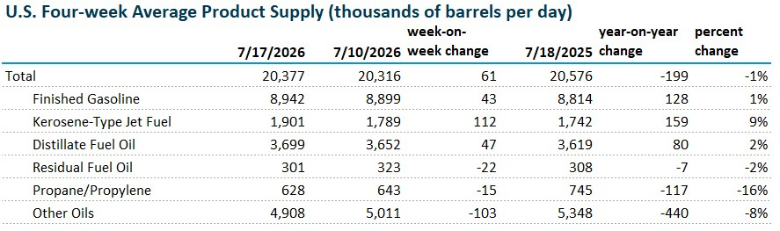
Over the past four weeks, total product demand averaged 20.4 million b/d, down 1% year over year. Gasoline demand increased 1% to 8.9 million b/d, while distillate demand increased 2% to 3.7 million b/d. Jet fuel demand increased 9% year over year. The increase demand for transportation fuels was offset by decreasing demand in residual fuel oil, propane, and other oils.
Principal contributors: EIA Staff
