


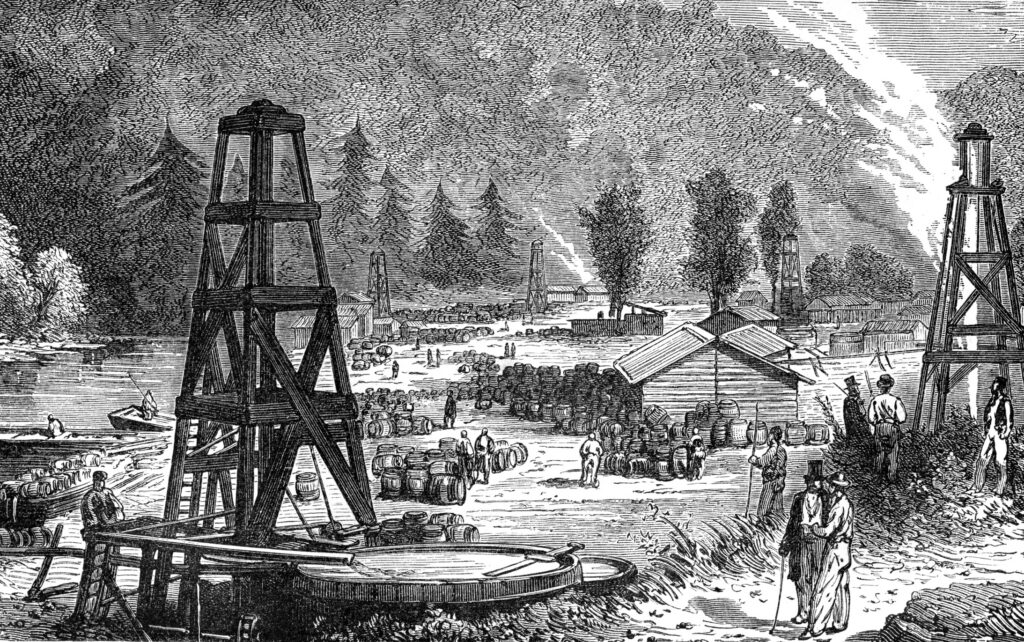
(Oil & Gas 360) By Greg Barnett, MBA – Hanging in my office is a Bowles map published in 1783, the year America secured its independence. Among the rivers, settlements, mountains, and boundaries of a young Republic appears a single word in western Pennsylvania: Petroleum.

The resource was known. The opportunity was not.
For nearly eighty years, the hydrocarbons beneath those hills remained largely a curiosity. They seeped from the earth, appeared on maps, and attracted occasional interest. Yet no industry emerged. No drilling programs followed. No pipelines crossed the countryside. No refineries were built. The resource existed. What was missing was the idea.
Then, in August 1859, Edwin Drake helped change that.
The significance of Drake’s well extends beyond the birth of the petroleum industry. It illustrates a recurring theme throughout American history. Time and again, the nation has known where resources existed long before it knew how to develop them economically. Progress arrived when geology, engineering, capital, and imagination converged.
The same pattern would repeat itself throughout the next century and a half.
Spindletop transformed oil from a specialized product into an abundant industrial resource. Offshore drilling extended the frontier beyond the shoreline. Prudhoe Bay pushed development into the Arctic. Each generation encountered what appeared to be a limit and then discovered a way beyond it.
Perhaps no modern example is more instructive than George Mitchell and the Barnett Shale.
Mitchell did not discover the Barnett. Geologists had known it was there for decades. Vertical wells had penetrated the formation countless times. The natural gas was not hidden. The challenge was economic production. Many viewed the Barnett as an interesting geological fact rather than a commercial opportunity. Mitchell and his engineers saw something different. Through persistence, experimentation, and engineering innovation, they helped transform a known resource into a producing reserve. What followed became one of the most significant energy developments of the modern era and helped reshape America’s energy outlook.
The rocks had not changed. The idea had.
Petroleum geologist Parke A. Dickey captured the principle decades ago:
“We usually find oil in a new place with old ideas. Sometimes, we find oil in an old place with a new idea, but we seldom find much oil in an old place with an old idea. Several times in the past we have thought that we were running out of oil, when actually we were running out of ideas.”
The observation is as relevant today as when it was first made.
The world currently consumes approximately 42 billion barrels of oil each year. That number does not care about opinions, political preferences, forecasts, or slogans. It simply reflects the scale of modern civilization’s energy requirements. Every year, depletion must be offset through production, innovation, substitution, improved recovery, or new discoveries.
Which raises an important question: Where are tomorrow’s frontiers?
The answer may be more familiar than many realize.
The oil shales of Colorado’s Western Slope have been studied for generations. Resource estimates have long been measured in the trillions of barrels in place. Utah contains substantial oil sands deposits. Methane hydrates beneath Arctic and offshore environments contain enormous quantities of natural gas. Geologists know these resources exist. They are hardly mysteries.
In some respects, they resemble the word “Petroleum” on that 1783 map. Known. Mapped. Measured. Discussed.
And still awaiting the combination of economics, engineering, technology, and persistence required to unlock them at scale.
Will these resources become major contributors to America’s energy future? No one knows. History cautions against certainty. The purpose is not to predict winners and losers. The purpose is to recognize that many of the industry’s greatest breakthroughs emerged from opportunities already visible to those willing to look.
In 1783, few could have imagined the chain of events that would lead from a single word on a map in western Pennsylvania to the Permian Basin, global LNG exports, deepwater platforms, and shale development. Likewise, future generations may view today’s known but undeveloped resources through a very different lens than we do.
America’s next hydrocarbon frontier may not be waiting to be discovered.
It may already be discovered. It may already be mapped.
It may already be sitting beneath Colorado, Utah, Alaska, the Gulf Coast, or formations we routinely drill through on the way to another target.
The challenge, as it has always been, is transforming possibility into reality.
Once a nation has declared its independence, the job is to stay independent.
For 250 years, America has met that challenge not merely through the resources beneath its soil, but through the ingenuity of those willing to see opportunity where others saw limitations. In 1783, a mapmaker recorded the existence of petroleum. Eight decades later, Drake helped reveal its potential. More than a century afterward, George Mitchell helped reveal the potential of shale.
The hydrocarbons were already there.
The ideas were still being written.
GREG BARNETT ARTICLES
By oilandgas360.com contributor Greg Barnett, MBA.
The views expressed in this article are solely those of the author and do not necessarily reflect the opinions of Oil & Gas 360. Please consult with a professional before making any decisions based on the information provided here. Please conduct your own research before making any investment decisions.
