


Our FRED graph above shows that unemployment is almost always doing one of two things: (1) declining slowly during expansions or (2) rising rapidly during recessions. Friedman (1964, 1993) compared this behavior to playing a musical instrument, describing it as a “plucking model” of unemployment.
Over the past 3 years, however, the unemployment rate has done something it almost never does: It has risen slowly from a low level, but there has been no sharp rise accompanied by a recession.
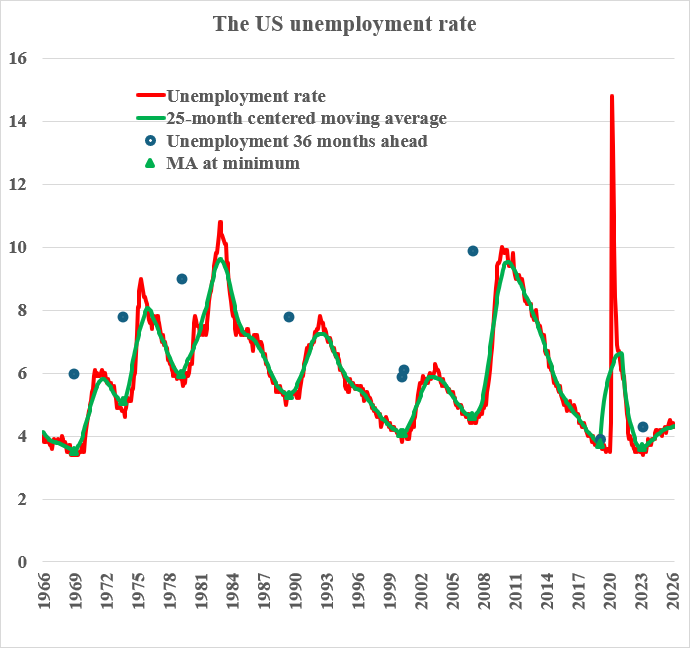
Our non-FRED graph below* illustrates how unusual this behavior is.
- The jagged red line is the US civilian unemployment rate.
- The smooth green line is a 25-month moving average of the unemployment rate that smooths out small movements in the rate.
- The green triangles show the minima of this moving average.
- The blue circles show the unemployment rate 36 months after the minimum.
In nearly every case —except 2020 (COVID) and 2023 — the unemployment rate climbs significantly in the 36 months after a local minimum. 2020 was exceptional because the huge COVID-related spike in unemployment rose and fell within 36 months. The past three years (2023-2026) have also been exceptional in that unemployment has risen very modestly and slowly from a very low level, but there has been no recession and no sharp uptick in unemployment.
It’s not obvious how to explain this very unusual behavior, but recent economic activity has been extraordinary. The 2020 recession associated with COVID was unprecedented, and the accompanying fiscal and monetary stimuli were quite large, leaving many consumers flush with cash. Unemployment rose to record levels, and then it declined at a record rate to a very low level. The 2020 recession was followed by supply shocks from the Russian invasion of Ukraine in 2022. In short, strange inputs tend to produce strange outcomes.
How these graphs were created: First graph: Search FRED for and select “unemployment rate.” *Second graph: FRED’s a great graphing tool, but can’t do everything: You can import data from FRED to your favorite application and create custom graphs like this one, which displays moving averages and only selected data points.
Suggested by Christopher Neely.
