



When investors think about municipal bonds, they often go right to state-issued general obligation bonds – the kind of debt backed by the taxing authorities of the state or city. However, the muni market is vast and features plenty of different subtypes. One of the biggest is education bonds. Public school districts, charter schools, private schools, colleges, universities, and community colleges often head to the municipal market to borrow muni. And historically, these bonds have been a good deal for investors.
But now, a threat could be emerging to the sleepy education bond sector.
With the Trump Administration’s plans to dismantle the Department of Education and education funding, analysts and pundits are now starting to wonder what the effect on municipal bonds could be.
Trump’s Plan
Established in 1979, the Department of Education oversees funding for public schools, administers student loans, and runs various programs that help low-income students. However, the department does not operate schools or set the curriculum, which is a common misconception. States and local school districts are responsible for that.
As part of his cost-cutting plans, President Trump has looked at the Department of Education as full of fat. And with that, the President issued an executive action back in March to U.S. Education Secretary Linda McMahon to “take all necessary steps to facilitate the closure of the Department of Education and return authority over education to the States and local communities.”
That full closure would take an act of Congress via a 60-seat majority as well as overcome a Democrat filibuster, various legal challenges, and injunctions currently in place to stop the closure.
In the meantime, the department has laid off staff, and the recently passed Tax Bill has changed funding schemes and increased taxes on higher education facilities.
Muni Bonds & Education
As we said in the opening, the municipal bond market is much more than simply general obligation bonds. More than two-thirds of the market falls among the so-called revenue-backed sector, which includes education bonds.
Making up around 7% of all municipal bonds outstanding, education bonds are issued by K-12 schools, public and private colleges, and charter schools to finance the construction or improvement of higher-education facilities or to help with ongoing operations. The bonds are paid for by students’ tuition payments or from the institution itself, such as from its endowment, patent portfolios, or other revenue-generating schemes.
Historically, education bonds —notably higher education bonds —have been a lucrative place for investors to find some extra yield and safe footing. After all, bonds issued by a large state university or a school like Yale are as good as gold.
But with the Department of Education news, the usually sleepy sector has been suffering. The S&P Municipal Bond Higher Education Index has had a total return of just 0.5% this year, which includes interest payments. And you can see from this chart that the big dip lower occurred as the Trump Administration news was announced.
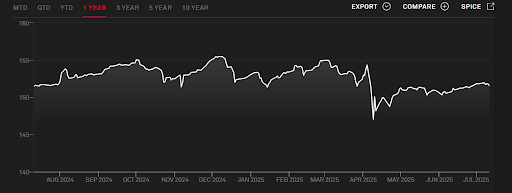
Source: S&P Indices
Adding pressure to this have been recent changes to university endowment taxes in the new Tax Bill. The current 1.4% excise tax rate on investment income for certain universities has changed to a multi-tiered structure of up to 8% based on a school’s student-adjusted endowment or assets per student. Worries about these tax changes have many investors questioning the safety of bonds issued and backed by endowments.
Naturally, the price changes have pushed up yields. Yields on the index are now closer to 4.5% as opposed to 4.2% at the start of the year. There have been some even more pronounced spikes. For example, the yield on a Harvard bond maturing in 2036 is now closer to 4.1%, up nearly a whole percentage point from the start of the year.
Those higher yields may be a good entry point for investors as the Department of Education news could be a case of “more bark than bite” for both higher education munis and K-12 bonds.
For one thing, the amount of actual funding that schools receive from the Department is very low. According to asset manager VanEck, the average K-12 school in the U.S. receives less than 10% of its funding from the federal government. And of that, the bulk does not come from the Department of Education. VanEck cites the National School Lunch Program and Head Start, which are funded via the USDA and the Department of Health and Human Services.
As for higher education, most universities have very diverse revenue streams. These include tuition, endowment income, and private grants. This mix of money can and does provide resilience against fluctuations in federal funding. Likewise, while federal funding has been cut for research, private foundations and grants have only increased in recent quarters, driven by the strength in asset values. Data shows that many universities have strengthened their balance sheets after COVID-19, saving much of the stimulus cash.
Finally, while enrollment data may paint a darker picture, looking deeper sheds more insight. Four-year schools have continued to hold their own, while the three million-seat decline from 2011’s peak enrollment has come chiefly from community colleges and for-profit institutions. Top-tier liberal arts and private schools continue to thrive on the enrollment front as well.
A High-Yielding Choice
So the Department of Education news and decreased funding are certainly worries for the education bond muni sector. However, they may not be the end of the world. There are still plenty of positives, and the higher yields offered by these bonds could be a great entry point for investors.
The question is how to do it. Given the variety of moving parts, differences in each college or K-12 school district, state, and various factors, active management could be best for the sector. Now, there are no dedicated education muni funds. But as one of the largest sectors within the revenue-backed category, they feature prominently among high-yield muni funds.
High-Yield Municipal Bond ETFs
These funds were selected based on their exposure to the high-yield municipal bond market. They are sorted by their YTD total return, which ranges from -0.3% to 7.8%. They have assets under management between $175M and $2.92B and expenses between 0.32% and 1.82%. They are currently yielding between 3.3% and 5.7%.
| Ticker | Name | AUM | YTD Total Ret (%) | Yield (%) | Exp Ratio | Security Type | Actively Managed? |
|---|---|---|---|---|---|---|---|
| XMPT | VanEck CEF Muni Income ETF | $239M | 7.8% | 5.7% | 1.82% | ETF | No |
| HYMB | SPDR® Nuveen Bloomberg High Yield Municipal Bond ETF | $2.59B | 4.3% | 4.2% | 0.35% | ETF | No |
| FMHI | First Trust Municipal High Income ETF | $573M | 4.3% | 4% | 0.70% | ETF | Yes |
| JMHI | JPMorgan High Yield Municipal ETF | $175M | 3.8% | 4.9% | 0.49% | ETF | Yes |
| HYD | VanEck High Yield Muni ETF | $2.92B | 3.6% | 4.3% | 0.32% | ETF | No |
| SHYD | VanEck Short High Yield Muni ETF | $329M | 2.8% | 3.3% | 0.35% | ETF | No |
| SHYM | iShares Short Duration High Yield Muni Active ETF | $356M | 0% | 4.1% | 0.41% | ETF | Yes |
| MINO | PIMCO Municipal Income Opportunities Active ETF | $263M | -0.3% | 4.1% | 0.49% | ETF | Yes |
The Trump Administration’s plans to reduce the Department of Education’s role have sent ripples throughout the municipal bond sector. However, education bonds may be better off than many investors have initially thought. While there are new risks, many universities and K-12 schools appear to be on a firm footing, with the Department’s role having a limited impact on their funding. With that, the current high yields in education bonds could be a big buy.
Bottom Line
News of the Department of Education’s closure has hurt the education bond mini subsector. However, those new high yields could be an attractive buying point for many investors. The damage may not be as severe as investors fear.
