


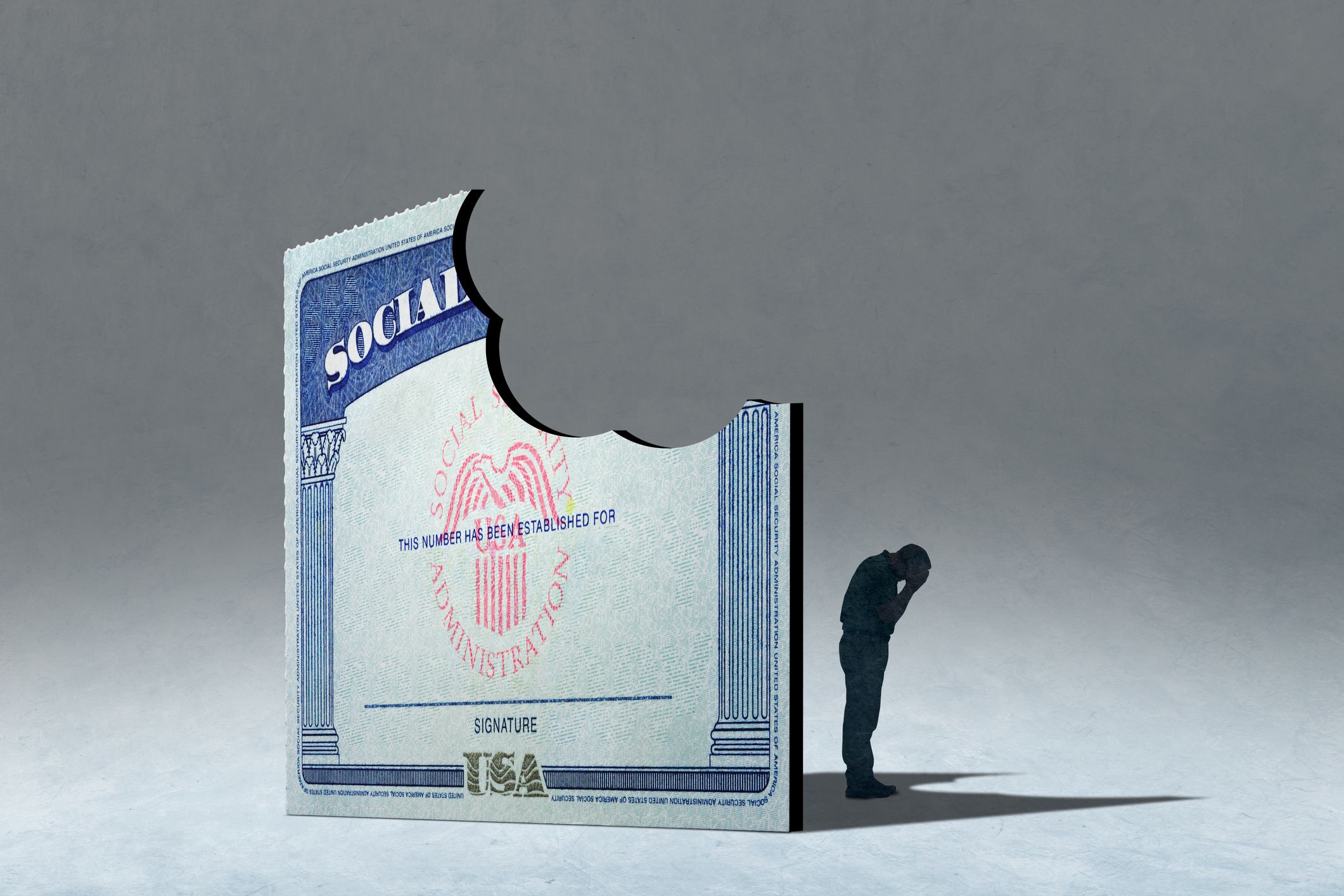
Imagine opening your mailbox less than seven years from now to find your monthly Social Security check chopped by nearly a quarter. That’s exactly what will happen in 2032 if lawmakers fail to shore up the retirement trust fund, according to a Committee for a Responsible Federal Budget (CRFB) report.
Under current law, insolvency triggers an automatic benefit reduction. This nationwide event, in which “no state is spared,” would affect roughly 63 million Americans — more than one in five people in the country. Depending on where you live, individual losses are projected to range from $459 to $556 monthly ($5,508 to $6,672 annually).
While Social Security was traditionally designed to replace 40% of pre-retirement income, 54% of American households now report having no dedicated retirement savings, according to the Federal Reserve’s Survey of Consumer Finances (SCF). Any cut will undermine tens of millions of beneficiaries, but those with little to no savings will be hit hardest, potentially forcing states to cover the critical shortfall. According to the CRFB, over 40 states would lose at least 1% of their Gross Domestic Product (GDP), while 15 states stand to lose between 1.5% and 1.9%.
Sign up for Kiplinger’s Free Newsletters
Profit and prosper with the best of expert advice on investing, taxes, retirement, personal finance and more – straight to your e-mail.
Profit and prosper with the best of expert advice – straight to your e-mail.
What you should know about the data

(Image credit: Getty Images)
The Social Security trust fund is expected to face insolvency in 2032, triggering a mandatory, immediate, across-the-board benefit cut. The 2026 OASDI Trustees Report estimates that the trust fund will run out in the fourth quarter of 2032, one quarter earlier than previously projected. If this happens, benefits will be cut by 22%.
The CRFB released its report, No State Spared: Mapping the Impact of Social Security’s Insolvency, on June 3, 2026, just days before the 2026 Social Security Trustees Report was issued on June 9, 2026. Because the CRFB based its calculations on the 2025 Trustees Report, its study projects a 24% reduction rather than 22%. For state-by-state benefit amounts, they used the most recent annual data from the 2024 OASDI Beneficiaries by State and Country Report.
The 2% difference is small enough that the CRFB data still provides a realistic, balanced simulation of how benefit cuts will impact retirees and state economies.
Individual wallet hit: average monthly cut per retiree

(Image credit: Getty Images)
Social Security benefits are tied to lifetime earnings and regional wage histories. As such, the dollar amount stripped from monthly checks varies depending on where a retiree lives. The average monthly cut to benefits nationally is $500 — almost the equivalent of a typical household’s monthly grocery budget. Cuts would surpass $500 in 29 states. The gap between the states facing the largest and smallest cuts is $97.
Retirees in wealthy, historically high-wage states will feel the deepest cash drain in their monthly budgets. In these regions, high lifetime earnings translate to larger scheduled Social Security benefits — which means a cut to benefits shaves off a larger chunk of cash.
Connecticut leads the nation in benefit cuts with a projected average monthly loss of $556. New Jersey and New Hampshire are close behind, with projected losses of $554 and $553, respectively.
On the other end of the spectrum, states with historically lower average wages are expected to see smaller nominal cuts to their benefits. However, the impact on retirees’ budgets may be more deeply felt in such states.
For example, retirees in Mississippi are projected to see the nation’s smallest average monthly cut at $459. However, these retirees are more likely to rely on Social Security as their sole source of income than those in states with historically higher average wages. In states with lower per-capita incomes, a $459 monthly reduction represents a consequential loss of purchasing power.
| Row 0 – Cell 0 |
State |
Amount |
|
U.S. average |
$500 |
|
|
Top 5- most severe cuts |
Row 2 – Cell 1 | Row 2 – Cell 2 |
|
Connecticut |
$556 |
|
|
New Jersey |
$554 |
|
|
New Hampshire |
$553 |
|
|
Delaware |
$549 |
|
|
Maryland |
$541 |
|
|
Bottom 5- least severe cuts |
Row 8 – Cell 1 | Row 8 – Cell 2 |
| Row 9 – Cell 0 |
Mississippi |
$459 |
| Row 10 – Cell 0 |
Louisiana |
$460 |
| Row 11 – Cell 0 |
Arkansas |
$469 |
| Row 12 – Cell 0 |
Kentucky |
$472 |
| Row 13 – Cell 0 |
New Mexico |
$472 |
Where the cuts will hit hardest

(Image credit: Getty Images)
The states with the highest percentage of residents receiving Social Security are concentrated in the five regions/states with older demographics. In these five states, more than 20% of people will feel the financial hit of lower benefits directly in their households, changing the fabric of local communities. Maine leads the nation with 22.9% of its total population likely to be directly impacted (300,000 people); West Virginia follows closely at 22.4% of its population (400,000 people).
Conversely, the areas with the smallest percentage of affected residents tend to have younger populations or distinct local workforce demographics. The District of Columbia has the nation’s lowest exposure at 10.5% of its population, accounting for 73,648 people. Texas has a relatively low percentage at 13.6%, yet because of its massive size, that “low” percentage translates to an incredible 4,258,266 people losing benefits.
|
State |
% of population affected |
Total number of people affected |
|
U.S. average |
17.7% |
60.1M |
|
Top 5 states- |
highest % of population affected |
Row 2 – Cell 2 |
|
Maine |
22.9% |
321,528 |
|
West Virginia |
22.4% |
397,256 |
|
Vermont |
22.0% |
142,926 |
|
Delaware |
21.1% |
221,860 |
|
New Hampshire |
21.0% |
295,195 |
|
Bottom 5 states- |
lowest % of population affected |
Row 8 – Cell 2 |
|
District of Columbia |
10.5% |
73,648 |
|
Utah |
12.1% |
423,029 |
|
Texas |
13.6% |
4,258,226 |
|
Alaska |
14.4% |
106,497 |
|
Colorado |
15.1% |
898.919 |
The “double-whammy” effect on local economies

(Image credit: Getty Images)
When analyzing the fallout from a potential Social Security benefit cut, a clear economic pattern emerges: lower-income states with older populations will experience a significantly larger percentage of Gross Domestic Product (GDP) loss. It sounds counterintuitive at first — after all, retirees in wealthier states lose more absolute dollars per check. Yet states including West Virginia (1.9%) and Mississippi (1.8%) face an economic hit nearly twice as severe as Connecticut (1.1%) or New York (0.8%).
Why is that? Wealthier retirees may have robust personal savings, 401(k) plans, or private pensions, allowing them to absorb a benefit cut. Retirees in lower-income states, however, generally rely on Social Security for the vast majority of their livelihood. Most of the benefits they receive are injected almost immediately into the local economy to pay for necessities — groceries, utilities, fuel, and healthcare. When those checks are cut, that spending stops instantly.
Because lower-income retirees spend their benefits locally, those dollars circulate through a compounding “multiplier effect.” When a state has both a high concentration of retirees and an economy in which federal benefits make up a larger slice of the total income pie, cutting those benefits pulls the rug out from under local commerce. In states like West Virginia, Mississippi, and Vermont, the sudden disappearance of hundreds of millions of dollars in consumer spending will directly hit the state’s total economic output.
|
Loss of GDP |
State |
Total benefit cut (in billions) |
|
1.1% |
U.S. average |
$345 |
|
1.9% |
West Virginia |
$2.2 |
|
1.8% |
Mississippi Vermont |
$3.0 $0.9 |
|
1.7% |
Maine South Carolina |
$1.8 $6.6 |
|
1.6% |
Michigan Montana Arkansas Alabama |
$12.1 $1.3 $3.2 $5.4 |
|
1.5% |
Florida Idaho Kentucky New Hampshire Pennsylvania Rhode Island Wisconsin |
$26.6 $2.1 $4.5 $4.5 $15.5 $1.2 $7.2 |
We need a fix
The economic ripples won’t stop at individual household checkbooks. Because most retirees pour their monthly benefits straight back into local businesses, grocery stores, and healthcare providers, this looming insolvency is a direct threat to state economies. Total benefit cuts are projected to drain more than 1% of GDP from 40 different states, hitting lower-income states with older populations like West Virginia, Mississippi, and Vermont the hardest.
Ultimately, this isn’t a problem safely tucked away for the next generation. The clock runs out in less than seven years, which means the upcoming legislative terms will decide whether lawmakers fortify the safety net or allow an unprecedented economic shockwave to hit their home states.
