


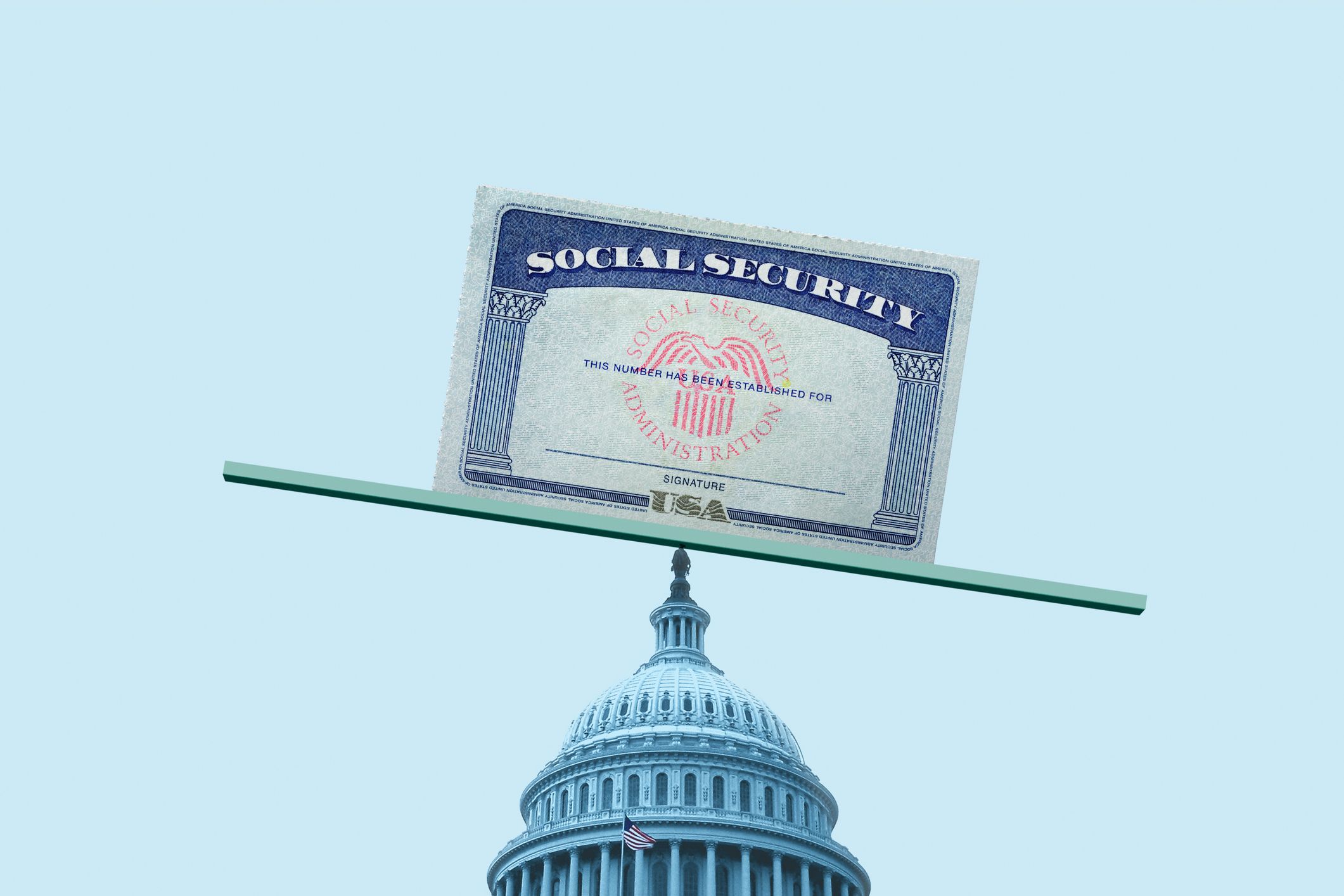
Social Security benefits have always been designed to protect individuals from a loss of income due to retirement, disability, or the death of a primary income earner, but how much you receive might be changing soon.
Current Social Security Administration (SSA) projections predict the program will face a funding shortfall by late 2032, triggered by a wave of retiring baby boomers outnumbering the younger workers paying into the system.
While the program survived a similar insolvency scare via a bipartisan overhaul in 1983, critics argue the current administration’s approach makes the upcoming crisis feel different. The SSA has faced shrinking staff, shuttered regional offices, and budgetary constraints — downsizing that advocates label as “efficiency,” but critics view as an attempt to “gut” the program.
Sign up for Kiplinger’s Free Newsletters
Profit and prosper with the best of expert advice on investing, taxes, retirement, personal finance and more – straight to your e-mail.
Profit and prosper with the best of expert advice – straight to your e-mail.
And now, enter: Trump Accounts. Launching July 4, 2026, the federally seeded vehicles were originally designed, supporters say, to help children build generational wealth.
However, the narrative about the accounts shifted when Sen. Ted Cruz (R-Texas), a key advocate, admitted the program’s “dirty little secret” is that these child savings vehicles are actually personal accounts intended to eventually privatize Social Security.
Here’s what you need to know.
Trump Accounts: The new face of Social Security?
Trump Accounts, which officially debut this month and are a key component of the 2025 Trump tax bill, were initially pitched as standard child savings accounts meant to help families save for a child’s future housing, higher education, or other qualifying expenses.
That definition was broadened last month during a panel on economic mobility at the Milken Institute Global Conference.
As mentioned, Sen. Ted Cruz (R-Texas), who originally proposed the Trump Account initiative, elaborated on how these child savings vehicles could be utilized.
“Here’s the dirty little secret. Trump accounts are Social Security personal accounts.”
Sen. Ted Cruz (R-Texas) told the audience, according to a transcript of the Breitbart News event.
Cruz told the audience, according to a transcript of the event.
For decades, various free-market think tanks and lawmakers have tried to overhaul Social Security by shifting it to private investment accounts. These efforts — most famously backed by then-President George W. Bush in 2005 — have historically failed due to prohibitive transitional costs and the risks of exposing retirees to market volatility (more on that later).
But Cruz outlined a strategy to bypass some potential roadblocks: start at the cradle.
“Babies grow up.” Sen. Cruz reasoned. “And that little girl who is born this year, she is going to be 70. And the math is, if you contribute regularly to [a Trump Account], by the time she is 18, she will have $170,000 in that account. By the time she is 35, she’ll have $700,000 in that account. And…very quickly after that, you get into the millions.”
- This strategy aligns with comments made nearly a year ago by U.S. Treasury Secretary Scott Bessent.
- Speaking at a Breitbart News event, Bessent similarly remarked, “In a way, it is a backdoor for privatizing Social Security.”
Facing subsequent criticism from Democratic lawmakers, Bessent later clarified on X that the proposed accounts were intended to supplement, rather than replace, existing Social Security benefits.
The push toward privatizing Social Security

(Image credit: Getty Images)
Historically, the biggest roadblock to privatizing Social Security has been the “pay-as-you-go” transition problem.
Current workers’ payroll taxes fund current retirees’ benefits. If younger workers suddenly diverted their payroll taxes into private accounts, the government would be left with a $1 to $3 trillion deficit, according to data from the Center on Budget and Policy Priorities (CBPP) and the Center for American Progress (CAP).
Trump Accounts, supporters claim, could circumvent this problem by building a parallel, privately-funded program before Social Security benefits are ever disrupted.
“We’re going to be able to go to parents and say, ‘Hey, you know that Trump account your kid has….and you’re seeing this compound growth? Wouldn’t you like to be able to keep a portion of your tax payments…wouldn’t you like to have a Trump account just like your kid does?'” Cruz suggested.
Yet critics argue that the seeming magic of compound interest on a Trump account would look a lot less magical during a market crash.
- Unlike private investment accounts, Social Security benefits have very low administrative overhead and provide a guaranteed, lifelong inflation-adjusted benefit.
- Meanwhile, Wall Street management fees can silently erode a retirement nest egg, disproportionately threatening low-income beneficiaries who lack financial literacy or access to alternative wealth management tools.
According to data from the U.S. Congress Joint Economic Committee, Social Security accounts for roughly 79% of income for the poorest 20% of “elderly” Americans. Half of women aged 65 and older would drop below the poverty line without guaranteed monthly checks. Under a privatized model, these citizens could be more susceptible to market risk and run out of funds early.
Social Security vs. Trump account taxes
The Social Security privatization debate isn’t just about how you accumulate wealth, but how that wealth is eventually taxed. Traditional Social Security benefits and private retirement accounts (like Trump Accounts) are taxed very differently.
Although the definitive tax rules for Trump Accounts are still being finalized, their structural similarity with traditional IRAs reveals stark contrasts to the tax treatment of Social Security benefits:
|
Feature |
Social Security Benefits |
Trump Account (Proposed) |
|
Taxable Amount |
Between 50% and 85% of benefits are taxable based on provisional income. |
Up to 100% of distributions are taxable, depending on the funding source. |
|
Basis Rules |
N/A. Benefits do not carry a tax “basis.” |
After-tax family contributions can be withdrawn tax-free. Government seeds ($1,000), employer matches, and all market growth are generally fully taxable. |
|
Tax Rate |
Ordinary federal income tax rates apply to the taxable portion. |
Ordinary federal income tax rates apply to the taxable portion. |
|
Early Access & Rules |
Accessible at age 62 (though reduced) up to age 70 (maximum delayed credits). |
Accessible at age 18 (for qualified expenses only). Withdrawals between 18 and 59½ face a 10% penalty unless an exemption applies. |
|
Mandatory Distributions |
None. |
Subject to required minimum distributions (RMDs) starting at age 73 or 75 (following traditional IRA guidelines). |
So, for example, a single retiree with provisional income over $34,000 can have up to 85% of their Social Security benefits included in their taxable income.
Meanwhile, proposed IRS rules dictate that the tax bill for a $34,000 distribution from a Trump Account depends entirely on who funded the account.
- If the beneficiary made $5,000 in after-tax contributions, that portion may be withdrawn tax-free.
- However, if the remaining $29,000 consisted of government-contributed amounts, market earnings, and compound interest, it would be 100% taxable at ordinary federal income tax rates.
- So, each withdrawal would be roughly 14.7% income tax-free ($5,000/$34,000), and 85.3% taxable income ($29,000/$34,000).
Plus, distributions from Trump Accounts must follow traditional IRA rules, including required minimum distributions (RMDs) once the beneficiary reaches the RMD age threshold.
The bottom line on Social Security benefits
If the U.S. Congress fails to act by the early 2030s, Social Security won’t simply vanish into bankruptcy. Instead, the system will trigger automatic benefit cuts, reducing payouts to roughly 78 cents on the dollar, according to the latest Social Security Board of Trustees Report.
For the average recipient, that translates to losing several hundred dollars a month, which can be a significant blow to the roughly 1 in 5 Americans who rely on the program.
The outlook is even more uncertain for late-career Gen Xers (currently aged 46 and 61), who are closing in on retirement. According to AARP polling, 41% of Gen Xers plan to rely on Social Security as their primary source of retiree income — meaning a sudden 22% benefit cut could derail their retirement.
History suggests that panic may be an effective motivator. The last major legislative rescue in 1983 passed just months before the trust funds ran dry. And already, proposals for the current crisis are rolling in.
- For instance, Sen. Elizabeth Warren (D-MA) and Bernie Moreno (R-OH) published a joint plan in the New York Times to eliminate the $184,500 payroll tax cap on high earners to fund the shortfall.
- Supporters say this could inject $3 trillion into the program over a decade.
- But some fiscal models, like those from the Tax Foundation, warn that raising the tax cap alone won’t be sufficient to guarantee long-term solvency, returning the system to annual deficits in only a few years.
At the same time, alongside child savings account vehicles, the Trump administration recently signed an executive order establishing TrumpIRA.gov to help adult workers without workplace plans to invest privately for retirement.
The IRS also recently issued guidance establishing a “safe harbor” for Trump Account gift tax reporting, meaning grandparents and relatives can contribute up to $5,000 without needing to file federal gift tax returns.
While the total elimination of Social Security may be unlikely, the launch of parallel private programs might mark a distinctive shift. The next iteration of American retirement security could rely less on traditional federal guarantees and more on private, market-driven accounts. Stay tuned for updates.
