


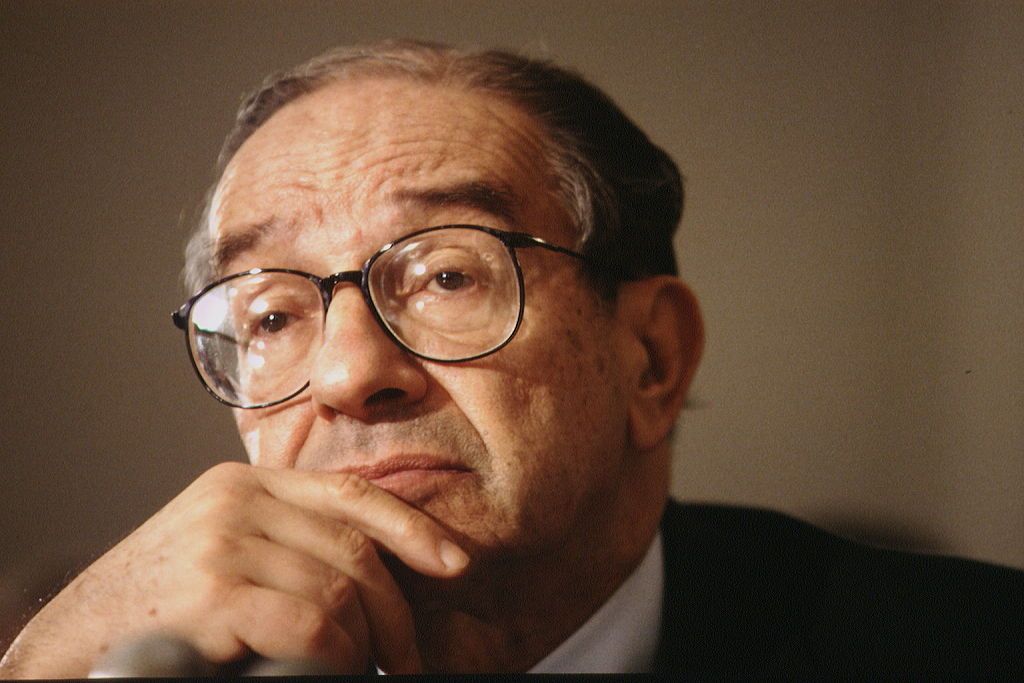
New Federal Reserve Chair Kevin Warsh has a message for his fellow central bankers: You talk too much. Indeed, a change has already come to Federal Open Market Committee (FOMC) communications with the first monetary policy statement under his leadership.
But policymakers of that kind of prominence are public figures. That’s just the way it is in the information age.
And Warsh knows as well as anyone that, as the 20th century bridged the 21st, Alan Greenspan established a model for the modern Fed chair, under chief executives of both parties, for better and for worse.
Sign up for Kiplinger’s Free Newsletters
Profit and prosper with the best of expert advice on investing, taxes, retirement, personal finance and more – straight to your e-mail.
Profit and prosper with the best of expert advice – straight to your e-mail.
The new Fed chair wants “regime change.” But he’s confronting the work of an old Fed chair who remains an icon on Wall Street and whose legend trickles down even to Main Street.
Greenspan, who was the top policymaker at the world’s most important central bank from 1987 until 2006, died on Monday at 100 years old.
Nominated by Ronald Reagan, he led the Federal Reserve under four presidents, through historic macroeconomic and geopolitical events, and was there longer than anyone but William McChesney Martin.
George H.W. Bush nominated him again in August 1991. Bill Clinton did it twice, in February 1996 for a third term and January 2000 for a fourth. George W. Bush nominated him for his fifth and final term in May 2004.

(Image credit: Pete Marovich/Bloomberg)
A lot has changed in the 20 years since Greenspan left the Fed. But Ben Bernanke, Janet Yellen and Jerome Powell stayed communicative throughout. And they stuck hard to the main objective: to stabilize the system.
Greenspan is survived by his wife of 29 years, the journalist Andrea Mitchell of MSNBC, with whom he formed one of the most prominent power couples of the era.
Here are five lessons we can learn from Fed Chair Alan Greenspan, a modern central banker of broad and deep experience.
1. Fedspeaking in tongues
Use your words… to the best of your ability… for the purpose you have defined.
“Since becoming a central banker,” he testified to Congress in September 1987, “I have learned to mumble with great incoherence. If I seem unduly clear to you, you must have misunderstood what I said.”
It’s a little bit ironic, but Greenspan instilled confidence, despite himself.

(Image credit: Tim Sloan/AFP)
There’s no question the guy was clever. And he certainly understood rhythm and timing. In his performance, Greenspan demonstrated a real grasp of where the science and the humanity of economics meet.
His actions during the dot-com era and the housing boom-bust cycle that followed suggest maybe he was a little too clever.
Something you may not know, however, is that Greenspan’s Ph.D. thesis, which was compiled from some of his previously published articles and was withheld from the public at the author’s request when he joined the Fed board, highlighted the impact of higher housing prices on consumer spending.
2. Black Monday
Be ready on Day One.
Little more than two months into his new order, shortly after taking his oath on August 11, 1987, Greenspan was forced to manage Black Monday, when the Dow Jones Industrial Average fell 22.6%.
That’s still the biggest single-day decline in Papa Dow’s 130-year history.

(Image credit: Anthony Pescatore/NY Daily News Archive)
From October 19, Greenspan guided Washington, D.C., Wall Street and Main Street into a historic rally and an economic boom that lasted, almost uninterrupted, through the 1990s.
The Dow recovered 288 points and regained more than 57% of its Black Monday loss within two trading sessions. Papa Dow posted a 0.6% gain in 1987, and it got back to its pre-crash all-time high within 23 months, by September 1989.
3. Fed man in the bathtub
Take a bath.
Later, in December 1996, he wondered, “But how do we know when irrational exuberance has unduly escalated asset values, which then become subject to unexpected and prolonged contractions,” as the dot-com era unfolded.
Now, here’s the rest of the story, as told by the late Fed chair himself in his 2007 memoir “The Age of Turbulence: Adventures in a New World”:
The concept of irrational exuberance came to me in the bathtub one morning as I was writing a speech. To this day, the bathtub is where I get many of my best ideas. My assistants have gotten used to typing from drafts scrawled on damp yellow pads–a chore that got much easier once we found a kind of pen whose ink doesn’t run. Immersed in my bath, I’m as happy as Archimedes as I contemplate the world.
4. Everybody wants to rule the world (but few are chosen)
And you have to be flexible.
Greenspan, Treasury Secretary Robert Rubin and Treasury Deputy Secretary Larry Summers famously formed what Time magazine called the “committee to save the world” in February 1999.
Indeed, it was like they had the whole planet on their back, like the main character in the main work of Greenspan’s favorite author, Ayn Rand, who celebrated Atlas and warned what would happen should he shrug.

(Image credit: David Hume Kennerly/The Gerald R. Ford Library)
Greenspan was an objectivist committed to hard-and-fast free market principles when he was tapped to chair the White House Council of Economic Advisors by President Gerald Ford in 1974.
By the time he was perhaps the key figure in the “age of turbulence,” Greenspan was an activist focused on practical means to stabilize an ever-more complex global financial system.
5. The accountant from Ipanema
Know who you are.
Bob Woodward of The Washington Post titled his 2000 biography “Maestro: Greenspan’s Fed and the American Boom.”
Woodward’s book was published well before Greenspan stepped away from the central bank in 2006. It also preceded the global financial crisis/Great Recession of 2007-09, a series of events that earned Greenspan another nickname, “Mr. Bubble,” bestowed upon him when he no longer held any real power.
For a long time, though, Greenspan seemed to conduct financial markets and global economic activity.
“Maestro” was also a nod to Greenspan’s career as a jazzman. Before he saved the world in the ’90s, the future central banker played with Stan Getz and Woody Herman in the ’40s. He even attended Juilliard in 1943-44.

(Image credit: Nicholas Hunt/Getty Images)
Greenspan, who was actually from the Washington Heights neighborhood of New York City, realized he was a better bean-counter than sax-player, so he started keeping his band’s books.
Held back from serving in the military during World War II because of a spot on his lung, the son of a single mother earned B.A. and M.A. degrees in economics from the New York University Stern School of Business in 1948 and 1950, respectively, and completed his Ph.D. in 1977.
As the global financial crisis devolved into the Great Recession, investors, traders, speculators and consumers started to wonder whether we need less “superhero” in our central bankers and more supervision from them.
Certainly, though, what Greenspan leaves is a worthy demonstration that a whole lot of competence and little likability can go a long way.
