


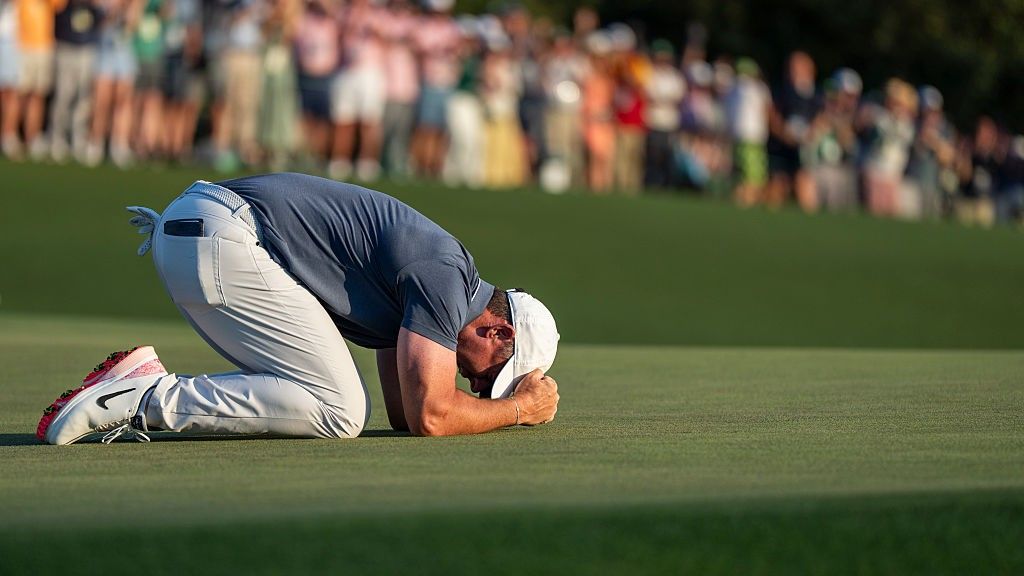
One of the great sports images in recent years shows golfer Rory McIlroy on his knees on the 18th green at Augusta, head bowed, mouth open in a roar, releasing the past. After 17 attempts and several famous heartbreaks, he had finally won the Masters.
The photograph is remarkable in its own right. What makes it more so is who took it. The perfect angle and perfect moment, it’s the kind of frame you’d expect from a career photojournalist. But it was a guy still learning the trade, who also happens to be Hall of Fame baseball legend Ken Griffey, Jr.
Griffey, who has appeared on 24 Sports Illustrated covers, described himself at the Masters as “the low man on the totem pole.” A beginner.
Sign up for Kiplinger’s Free Newsletters
Profit and prosper with the best of expert advice on investing, taxes, retirement, personal finance and more – straight to your e-mail.
Profit and prosper with the best of expert advice – straight to your e-mail.
No matter what you used to be, retirement asks something hard of nearly everyone. When you step away from the operating room, the classroom, or the corner office, you’re asked to learn how to be a beginner all over again.
Not everyone is ready for it. A 2026 survey from the Transamerica Center for Retirement Studies found pursuing hobbies as one of the top three things workers dream about for retirement, behind only travel and time with family.
But the transition can be harder than the dream suggests. In her book Rethinking Retirement for Positive Ageing, researcher Denise Taylor concludes that up to one-third of retirees find the transition either stressful or notice a decline in well-being, with another 10-25% experiencing real adjustment difficulties, including mental health complications.
As Griffey put it to the New York Times: “I think it’s all about getting better and trying to learn things. If you get stuck or you only do one thing, your mind is going to die. I like taking pictures. So why not learn to take better pictures?”
The hardest thing about retirement, for many, may not be the math. It’ll be doing something you’re not yet good at and sticking with it long enough to get better. But experts say the people who do tend to come out the other side with a better retirement.
The challenge of beginning again in retirement
For most of your career, you’re rewarded for your expertise. Retirement can mean the opposite — to walk into a pottery class, a Spanish lesson or a pickleball court as the worst person in the room.
“The biggest obstacle to becoming a beginner is fear, especially the fear of looking incompetent,” says Joe Casey, founder and retirement coach at Retirement Wisdom. “Many people haven’t been bad at something in decades. Becoming a novice again can rattle you at first.”
For years, your value was tied to having the answers. Being a novice forces you to confront who you are when you don’t.
Casey recommends a small reframe: stop calling it a retirement hobby and start calling it an experiment. “When you call something an experiment, the pressure drops. You’re not performing for something with a score or a grade. You’re just exploring.”
The research backs the instinct. Stanford psychologist Carol Dweck’s decades of work on “growth mindset” (the belief that ability is built rather than fixed) finds people who view themselves as learners are more resilient and open to new experiences.
And a study from the University of Texas at Dallas’s Center for Vital Longevity found older adults who took up genuinely new and demanding skills, like digital photography or quilting, showed measurable memory gains compared with a control group doing familiar leisure activities.
In other words, the discomfort of being new wasn’t the price of admission. It was the part that did the work.
“Someone might have $8 million and agonize over booking a first-class seat.” — Mitchell Kraus
Mastering the switch from saving to spending
Besides personal pursuits, there’s a second skill with which retirees often feel like beginners: spending. After decades of trying to get a number to go up — saving more, deferring gratification, watching the balance grow — retirement is a time to flip the relationship.
“Retirement is arguably the first time in a person’s adult life that being a beginner is financially safe,” says Jeff Judge, CFP® and managing partner of Chesapeake Financial Planners. “Most people have never practiced it.”
And many never get comfortable with it. A recent Morningstar report notes that retirees following typical “safe” strategies — withdrawing only dividends and interest, taking just their RMDs, or sticking to the 3.9% base-case withdrawal rate — tend to finish 30-year retirements with significant balances left over.
Judge sees it constantly. One client with more than $2 million in investable assets called him in a near-panic after buying a $4,000 piece of furniture. “He’d done nothing wrong. But the number went down, and that felt like failure. The money was built as a score, not a tool.”
The pattern shows up at every wealth level. “Someone might have $8 million and agonize over booking a first-class seat,” says Mitchell Kraus, CFP® and founder of Capital Intelligence Associates. “Hoarding capital you’ll never spend isn’t prudence, it’s waste of a different kind.”
What seems to break the spell is the same interventions that help people stick with a new hobby, such as structure and repetition. Several advisers described setting up automatic monthly transfers that look and feel like the paychecks clients used to receive while working. After a year or two of watching the numbers work as designed, the anxiety eases.
The two halves of the retirement-beginner problem are really the same problem. Brenna Baucum, CFP® and founder of Collective Wealth Planning, observes: “Retirement is often the first time in decades that highly accomplished people have to be beginners again. The clients who thrive are usually the ones who embrace that reality rather than resist it.”
How to excel as a ‘beginner’
A few practical moves can help you get through the beginner phase.
A good place to start is among peers. “The people who push through rarely do it alone,” Casey says. “They join a group and learn from others who remember what it felt like to be new. Belonging comes first, before building confidence.” In-person, low-stakes group settings, such as community art schools or beginner leagues, can help produce more durable engagement than learning solo.
Most people who quit an activity do so before reaching the point where it starts to feel good, Casey notes. That’s why he suggests committing to a fixed window (a semester, 12 sessions, 90 days, etc.) before deciding to stop.
On the spending side, several advisers recommend creating a line item in the financial plan specifically for experiences, classes and travel. “Giving something a place in the plan can feel like giving yourself permission to enjoy it,” Baucum says.
And it helps to think about time as the central currency. Kraus asks his newly retired clients what they’ll do with the roughly 2,000 hours a year a full-time job used to take. “Without intentional design, that freedom becomes disorientation. We shift the focus from ‘return on investment’ to ‘return on life.'”
The performance researcher Steve Magness writes that the people most comfortable trying new things aren’t smarter or tougher than the rest of us. They just have a higher tolerance for looking foolish along the way, along with a different source of pride. Researchers have identified two kinds: authentic pride, rooted in mastery and effort, and hubristic pride, rooted in ego. The bravado, research suggests, usually masks insecurity.
On the other side of the camera, Griffey tries to bring the perseverance and authentic pride he showed on the diamond to his life as a photographer. “The learning curve is massive,” he said of his Masters experience. “There’s that old saying, be comfortable being uncomfortable. That was that whole week at Augusta. I was uncomfortable the whole time, but also understood certain things in the big picture.”
The rest of us could probably stand to try something like it.
