


Today we get the CPI data that will finally unleash Trump’s critics and cause them to criticize the war effort to rein in Iran. (Just kidding – obviously Trump’s critics need no excuses!) We see the direct effects of the war on consumer energy prices, which the consensus expects to produce a headline m/m, seasonally adjusted CPI figure of +0.96% (consensus on core is +0.28%). The range of estimates is 0.6% to 1.5%, which is sort of crazy…it is hard to imagine how you get a +0.6% out of this. (Most of us are around 0.9%-1.1% though.) A couple of notes before we look at the actual number.
First, note that at this time of year the seasonally-adjusted number is lower than the NSA number is. NSA, the Bloomberg consensus is for about +1.15%!
Second, it is important to remember that before the Iran war, we were still unwinding the data artifacts that resulted from the 1-month gap in the CPI produced by the government shutdown last fall. Next month’s core inflation numbers were already going to be a bit higher than trend because of the payback in rents at the 6-month point after the October gap. The war doesn’t make the unraveling any easier, though we were getting to the end of that process. Key point though is that we don’t yet have a read on where trend core or median CPI is settling.
Which brings us to the main point looking forward to today’s figure, and thinking about the effect the war is having. The impact on energy prices is pretty transparent, and while important it is also ‘transitory.’ Energy prices mean-revert, and eventually gasoline prices will either decline back to some semblance of where they were – or they will at least flatten out and no longer contribute plusses to the monthly figure. There is almost no trend component to energy, which is why policymakers want to look at core and median. So that is the real item of importance today, and for the next couple of months: we want to look at signs of pass-through beyond energy, not just into core commodities (higher energy prices pass through via things like shipping and packaging, for example, pretty quickly) but more importantly into supercore (core services ex rents). So next month, we may or may not see lower gasoline prices…but we will also see the rents payback (higher), pass-through into core commodities (higher), and possibly growing signs of an inflation uptick beyond that – not just from the war, but from any trend that was developing pre-war. I take administrative notice of the Atlanta Fed’s Wage Growth Tracker, which in February and March rose from 3.6% y/y to 3.9% y/y. There isn’t a war effect in that, and while this doesn’t exactly break the downtrend in nominal wages (see chart below, source Bloomberg)…it also wasn’t entirely unexpected that wage growth would be bottoming near here.

Finally one last pre-number observation: I want to reprise my chart from last month showing 5-year inflation swaps on the Continent compared to 5-year inflation swaps in the US. The US swaps curve is still not showing any effect at all from the war.

Now, as I said energy prices are mean-reverting so the forwards shouldn’t show a lot of impact…but it almost always does because no one ever treats inflation as unit root. That is, when spot inflation goes up the curve almost always shifts up a bit along its length because every swap on the curve starts with a 1-year swap. If energy mean reverts, the 1y, 1y forward should shift lower to reflect that…but it almost never does. This is unusual, and curious. And it sort of implies a strengthening dollar, since if global inflation is higher because of aftereffects from the war, then weaker currencies will end up owning more of that inflation than stronger currencies. That happens to fit my thesis of dollar strength, but it’s still weird.
And now for the number…
Headline CPI came in at +0.865% seasonally-adjusted m/m, raising the y/y to 3.3% from 2.4%. The year/year number will rise further over the next few months to approach 4% before hopefully receding some. The NSA number for headline (which matters for USDi accretion in May – get it while it’s hot!) was +1.049% m/m. Seasonally-adjusted Core CPI was very tame +0.196%.

Among the major categories, Apparel was +1% while Medical Care, Recreation, and Other goods and services were all negative m/m.

Now, core goods rose to +1.18% y/y. This is interesting, because one thing that pundits were saying that that there was ‘some evidence that the invalidation of Trump tariffs led to lower goods prices.’ Not really. Apparel as I said was +1%, and core goods rose y/y even with surprising softness in Used Cars (where surveys suggested an increase). Core Services also ticked up, which is very interesting given what we saw in rents.

Primary rents were +0.19% m/m, and by my calculation will be the median category (spoiler alert: my estimate of median CPI is +0.19%). Owners’ Equivalent Rent was +0.28% m/m. Both were higher than last month’s surprises but y/y is still sagging.

Airfares were up +2.67% m/m, which is one core service that actually has a lot of energy in it. We’ll see a further rise from Airfares going forward. But here is supercore, and as I said this is the part we want to watch closely. We knew energy would be higher, but it mean-reverts. Rents will jump higher next month to re-pay the October zero, but rents already look like they’re leveling off after a long decline. We need to watch core commodities for energy pass through over the next few months. But the key is Core Services less Rent of Shelter. It has a small hook higher over the last couple of months, which is consonant with the Median Wages chart I showed earlier.

Wages, potentially pushed higher a little bit because of the shrinking workforce due to ex-migration, feed into supercore and that’s the feedback loop that I think will end up keeping us in the mid-to-high 3%s for median over the medium term.
Core ex-shelter rose to 2.27% from 2.09%. That’s not a big thing, but it’s something to watch. Rents are now definitely holding down overall inflation slightly. Rents are tracking below my model right now, but within the error band. They may just be running ahead of my model by a few months. Or, the ex-migration may be weighing on rents at the same time it is helping wages. Certainly, that will be true in some areas seeing larger ex-migration effects.
There was a significant fall in Medicinal Drugs this month, -1.05% m/m. It brought the whole Medical Care subindex down on the month, even though Doctors’ Services (+0.67%) and Hospital Services (+0.41%) both rose.
I noted before that my expectation for Median CPI is +0.19% m/m, which is not alarming. But here is the list of core categories below and above a 10% annualized m/m change:
Below: Miscellaneous Personal Services (-14% annualized) and Medical Care Commodities (-11%, mostly the aforementioned pharmaceuticals).
Above: Women/Girls’ Apparel (+23%), Misc Personal Goods (+21%), Public Transportation (+20%), Car/Truck Rental (+16%), Motor Vehicle Maintenance and Repair (+16%), Jewelry and Watches (+12%), Tenants’ and Household Insurance (+11%), and Footwear (+11%).
You can see in that, and in what I’m about to show, what the Fed’s study (https://www.federalreserve.gov/econres/notes/feds-notes/is-the-inflation-process-in-advanced-economies-different-after-the-pandemic-20260330.html) recently suggested, and that is a distribution that is shifted to the right even though it has tails on both sides and a median which, thanks to soggy rents, is scootching (technical term) to the left a little.

Median y/y should be roughly 2.7% after today’s figure, which I think ought to be about the low. One reason is that with median wages now 1.2% above median inflation, the upward feedback loop will help support prices.

Two final charts. The first one is the distribution of y/y changes. The big middle finger is rents, and that dominates the median calculation. But if you remove the middle finger, you can see there is a very broad middle, from 2% to nearly 6%.

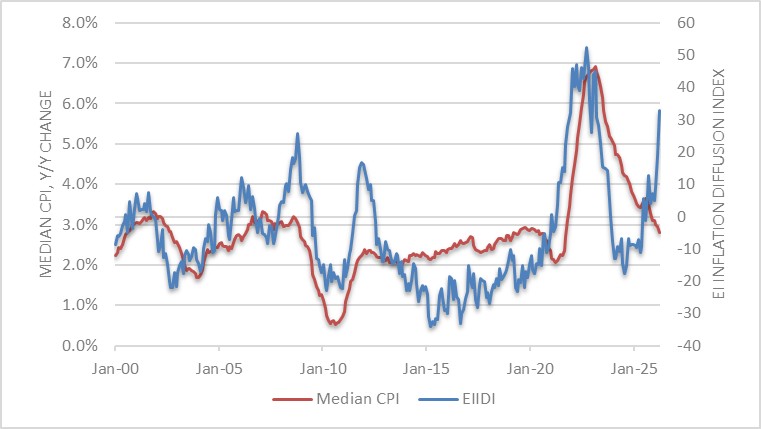
And the final chart, BOOM, is the Enduring Investments Inflation Diffusion Index, which measures the distribution in a single number. Overall, there isn’t a lot in today’s report that is immediately alarming. But this captures the subtle piece that is alarming, and that is the broadening of inflation pressures.

The underlying message is that as the October surprise is resolving, and the war volatility is passing through, we are seeing beneficial moves in rents (lower) and wages (higher) thanks mostly to the shrinking of the pool of available labor. But outside of rents, which flatters the data, there are upward pressures. They don’t look disturbing, because it isn’t one thing (“oh, Used Cars was higher this month and that did it”) but small accelerations in a lot of things. That’s what we need to be watching over the next few months, as energy prices revert. Longer-term pass-through dynamics will matter and will show at asynchronous intervals. But there’s also a signature here of a turn back higher in inflation.
What does it mean for policy? It doesn’t really matter right now because there’s no way that Powell, due to his animus with Trump, is going to lower rates in the near term absent a financial accident and there’s nothing in the raw numbers that will make the Fed reach for the ‘tightening’ button. It’s not a lovely setup for the summer, though. I actually still think the next move will be an ease, but right now it looks to me like short rates aren’t due to move far in either direction for a while.
