


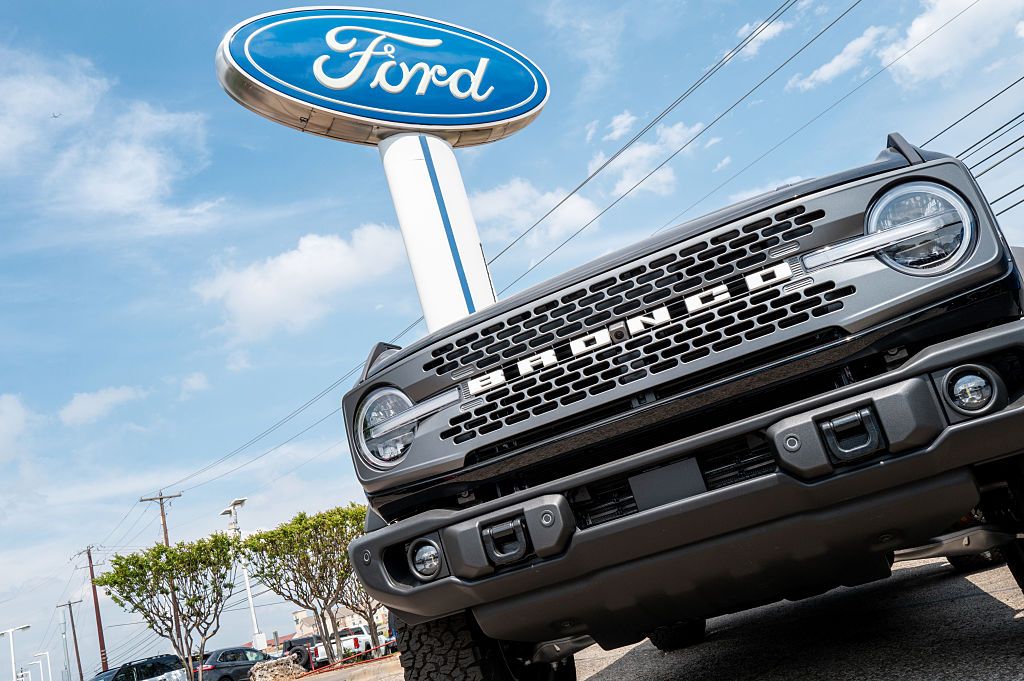
If anything is as American as baseball, hot dogs and apple pie, it’s got to be Ford Motor (F).
The legendary car company gave us everything from the Model T to the Mustang to the F-150 pickup truck. During World War II, doing its part in the Arsenal of Democracy, Ford shifted to military production, churning out B-24 bombers.
Few enterprises have such a proud and illustrious past. Unfortunately for long-time Ford shareholders, the company’s glory days look very much to be a 20th century story.
Article continues below
Sign up for Kiplinger’s Free Newsletters
Profit and prosper with the best of expert advice on investing, taxes, retirement, personal finance and more – straight to your e-mail.
Profit and prosper with the best of expert advice – straight to your e-mail.
Thanks to the explosive popularity of its Explorer SUVs and F-Series trucks, Ford was the most profitable automaker in the world – back in 1999. The stock hit its all-time high that year. It hasn’t come close to recovering ever since.
True, the past 20 years have rewarded nimble capital-light companies over plodding, capex-intensive firms like car manufacturers. The global auto market has changed dramatically, too, with greater competition from overseas entrants and the emergence of electric vehicles.
But Ford has also suffered plenty of self-inflicted wounds.
Although the company famously avoided a bailout by the federal government during the Great Recession, it had to mortgage nearly all of its assets in order to stay liquid.
Then there’s Ford’s long-running issues with manufacturing quality. The company regularly leads all U.S. automakers in total recalls. Not only does that do damage to the brand, but it’s a financial headache, as well. In 2024, Ford blew $2 billion in a single quarter on an unexpected spike in warranty costs.
In another wallop, Ford’s EV strategy has been a disaster. Declining sales for models such as the F-150 Lightning and Mustang Mach-E led the company’s EV division to report a loss of nearly $5 billion in 2025. Ford expects the division to lose another $4 billion to $4.5 billion in 2026.
Adding insult to injury, Ford expects tariffs on steel and aluminum to cut operating income by almost $2 billion annually.
Oh, and the balance sheet is bloated, too. Ford’s consumer financing business comprises about 85% of the company’s massive debt load. With more than $160 billion in total debt, Ford stock’s debt-to-equity ratio stands at 4.54. That’s up from 2.84 five years ago, and it tends to make shareholders nervous. Higher and potentially volatile interest costs makes it harder to model future earnings.
The bottom line on Ford stock
As you may have guessed by now, Ford stock has been a big-time market laggard for a very long time.
Over its entire life as a publicly traded company, the consumer discretionary stock generated an annualized total return (price change plus dividends) of just 3.6%. The S&P 500 delivered an annualized total return of 10.6% over the same span.
It’s pretty much the same story over the past three-, five-, 10-, and 15-year periods. Ford stock lags the broader market, and by wide margins.
Which brings us to what $1,000 invested in Ford stock two decades ago would be worth today. Spoiler alert: it’s ugly.

Have a look at the above chart and you’ll see that if you put a grand into Ford 20 years ago, today it would be worth about $2,900. That’s an annualized total return of just 5.4%. The same sum invested in an S&P 500 index fund would be worth about $7,300, or 10.5% annualized.
Where does Ford stock go from here? Wall Street is pretty cool on the name, giving it a consensus recommendation of Hold. Of the 22 analysts covering F stock surveyed by S&P Global Market Intelligence, two rate it at Strong Buy, three say Buy, 16 rate it at Hold and one calls it at Strong Sell.
More Stocks of the Past 20 Years
TOPICS
