Close Menu
Money MechanicsMoney Mechanics
    What's Hot

    Tax Refund Status: 5 Ways You Could Accidentally Delay Yours

    March 17, 2026

    Can AI Help You Find a Bigger Tax Refund?

    March 17, 2026

    3 Altcoins Push Toward Key Resistance Levels as Upside Momentum Builds

    March 17, 2026
    Facebook X (Twitter) Instagram
    Trending
    • Tax Refund Status: 5 Ways You Could Accidentally Delay Yours
    • Can AI Help You Find a Bigger Tax Refund?
    • 3 Altcoins Push Toward Key Resistance Levels as Upside Momentum Builds
    • Redfin Economists’ Weekly Take: Rates Will Jump Around As Markets Weigh Iran War and Fed Outlook
    • Essential Financial Ratios for Analyzing Pharmaceutical Stocks
    • Futures Little Changed as Oil Resumes Ascent After One-Day Pause; Two-Day Fed Policy Meeting Kicks Off
    • Structural Policy Choices Come Home to Roost – Oil & Gas 360
    • Pioneer of Monetarism and Free Markets
    Facebook X (Twitter) Instagram
    Money MechanicsMoney Mechanics
    • Home
    • Markets
      • Stocks
      • Crypto
      • Bonds
      • Commodities
    • Economy
      • Fed & Rates
      • Housing & Jobs
      • Inflation
    • Earnings
      • Banks
      • Energy
      • Healthcare
      • IPOs
      • Tech
    • Investing
      • ETFs
      • Long-Term
      • Options
    • Finance
      • Budgeting
      • Credit & Debt
      • Real Estate
      • Retirement
      • Taxes
    • Opinion
    • Guides
    • Tools
    • Resources
    Money MechanicsMoney Mechanics
    Home»Earnings & Companie»Energy»Structural Policy Choices Come Home to Roost – Oil & Gas 360
    Energy

    Structural Policy Choices Come Home to Roost – Oil & Gas 360

    Money MechanicsBy Money MechanicsMarch 17, 2026No Comments4 Mins Read
    Facebook Twitter LinkedIn Telegram Pinterest Tumblr Reddit WhatsApp Email
    Structural Policy Choices Come Home to Roost – Oil & Gas 360
    Share
    Facebook Twitter LinkedIn Pinterest Email


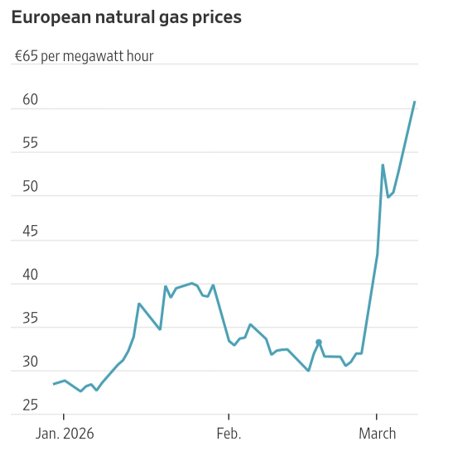
    (Oil & Gas 360) By Greg Barnett, MBA – European natural gas prices have spiked sharply once again, underscoring that Europe’s energy vulnerability is structural rather than cyclical. After trading in a relatively narrow range through much of January and February 2026, prices surged abruptly in early March. The scale and speed of the move reinforce how exposed Europe remains to supply disruptions, policy constraints, and import dependence.

    Structural Policy Choices Come Home to Roost – Oil & Gas 360

    A Calm That Proved Illusory

    Two years ago, in 2024, European gas prices appeared to have normalized. Benchmark TTF prices generally averaged between €26 and €35/MWh, far below the extremes reached in 2022. That apparent stability, however, was not the result of a structurally stronger supply system. Instead, it reflected temporary factors such as emergency LNG inflows, industrial demand destruction, and elevated storage levels. Once those buffers began to erode, price volatility returned quickly, as illustrated in Figure 1.
    Europe’s Natural Gas Price Spike: Structural Policy Choices Come Home to Roost- oil and gas 360
    Figure 1. European natural gas prices (TTF), January–March 2026. Prices remained largely range‑bound between €27–32/MWh through January and most of February before surging rapidly toward €60–65/MWh in early March.

    The Decline of European Gas Production

    At the core of Europe’s vulnerability is the long‑term decline in domestic natural gas production, driven primarily by policy choices rather than resource exhaustion. Over the past decade, upstream investment incentives were withdrawn, permitting timelines lengthened, and political signaling discouraged new development. The phase‑out of the Groningen gas field alone removed one of Europe’s largest sources of flexible supply, with no equivalent replacement allowed to emerge.

    Germany’s Return to Coal

    Germany illustrates the contradictions embedded in Europe’s energy transition. While natural gas is frequently described as a transition fuel, Germany has repeatedly shifted back toward coal when gas prices spike. Following the nuclear exit, coal has served as the marginal stabilizer during periods of tight gas supply, prioritizing system reliability and affordability but undermining emissions targets.

    France and the Prohibition of Domestic Supply

    France represents the opposite extreme. Hydraulic fracturing has been banned since 2011, and subsequent legislation prohibited new oil and gas exploration entirely. This eliminated any possibility of unconventional gas development regardless of market conditions, leaving France heavily reliant on imported gas despite its status as a major energy consumer.

    The United Kingdom’s Shrinking North Sea

    The United Kingdom, once a net exporter, now faces a similar deterioration in supply. North Sea gas production is in structural decline, exacerbated by high effective tax rates and regulatory uncertainty. With minimal storage capacity, the UK is frequently forced to pay a premium during periods of tight supply, contributing to broader regional price volatility.

    Sanctions, LNG, and American Supply

    Overlaying these domestic constraints are sanctions and the collapse of Russian pipeline gas, which previously supplied more than 40% of EU demand. The resulting gap has been filled primarily by American LNG. While U.S. exports have stabilized volumes, they have tied Europe’s gas prices to global LNG competition, shipping constraints, and weather‑driven volatility.

    Renewables Investment Without System Resilience

    Europe has invested hundreds of billions of euros annually in wind and solar generation, yet insufficient grid expansion and limited dispatchable backup capacity remain critical weaknesses. Curtailment and congestion costs are rising even as gas remains indispensable during periods of low renewable output.

    Conclusion

    Figure 1 captures the underlying reality of Europe’s gas market: prices appear stable until they suddenly are not. Europe’s recurring gas price spikes are not anomalies. They are the predictable outcome of constrained domestic supply, high import dependence, and an energy transition that prioritized capacity additions over system resilience.

    By oilandgas360.com contributor Greg Barnett, MBA.

    The views expressed in this article are solely those of the author and do not necessarily reflect the opinions of Oil & Gas 360. Please consult with a professional before making any decisions based on the information provided here. Please conduct your own research before making any investment decisions.


    Source link

    Share. Facebook Twitter Pinterest LinkedIn Tumblr Telegram Email
    Previous ArticlePioneer of Monetarism and Free Markets
    Next Article Futures Little Changed as Oil Resumes Ascent After One-Day Pause; Two-Day Fed Policy Meeting Kicks Off
    Money Mechanics
    • Website

    Related Posts

    Definition, Accounting, Types, and Uses

    March 17, 2026

    The Power Behind the AI Boom: Why U.S. electricity demand is rising again: by Oil & Gas 360

    March 17, 2026

    What It Is and How to Estimate It

    March 16, 2026
    Add A Comment
    Leave A Reply Cancel Reply

    Top Posts

    Tax Refund Status: 5 Ways You Could Accidentally Delay Yours

    March 17, 2026

    Can AI Help You Find a Bigger Tax Refund?

    March 17, 2026

    3 Altcoins Push Toward Key Resistance Levels as Upside Momentum Builds

    March 17, 2026

    Redfin Economists’ Weekly Take: Rates Will Jump Around As Markets Weigh Iran War and Fed Outlook

    March 17, 2026

    Subscribe to Updates

    Please enable JavaScript in your browser to complete this form.
    Loading

    At Money Mechanics, we believe money shouldn’t be confusing. It should be empowering. Whether you’re buried in debt, cautious about investing, or simply overwhelmed by financial jargon—we’re here to guide you every step of the way.

    Facebook X (Twitter) Instagram Pinterest YouTube
    Links
    • About Us
    • Contact Us
    • Disclaimer
    • Privacy Policy
    • Terms and Conditions
    Resources
    • Breaking News
    • Economy & Policy
    • Finance Tools
    • Fintech & Apps
    • Guides & How-To
    Get Informed

    Subscribe to Updates

    Please enable JavaScript in your browser to complete this form.
    Loading
    Copyright© 2025 TheMoneyMechanics All Rights Reserved.
    • Breaking News
    • Economy & Policy
    • Finance Tools
    • Fintech & Apps
    • Guides & How-To

    Type above and press Enter to search. Press Esc to cancel.