


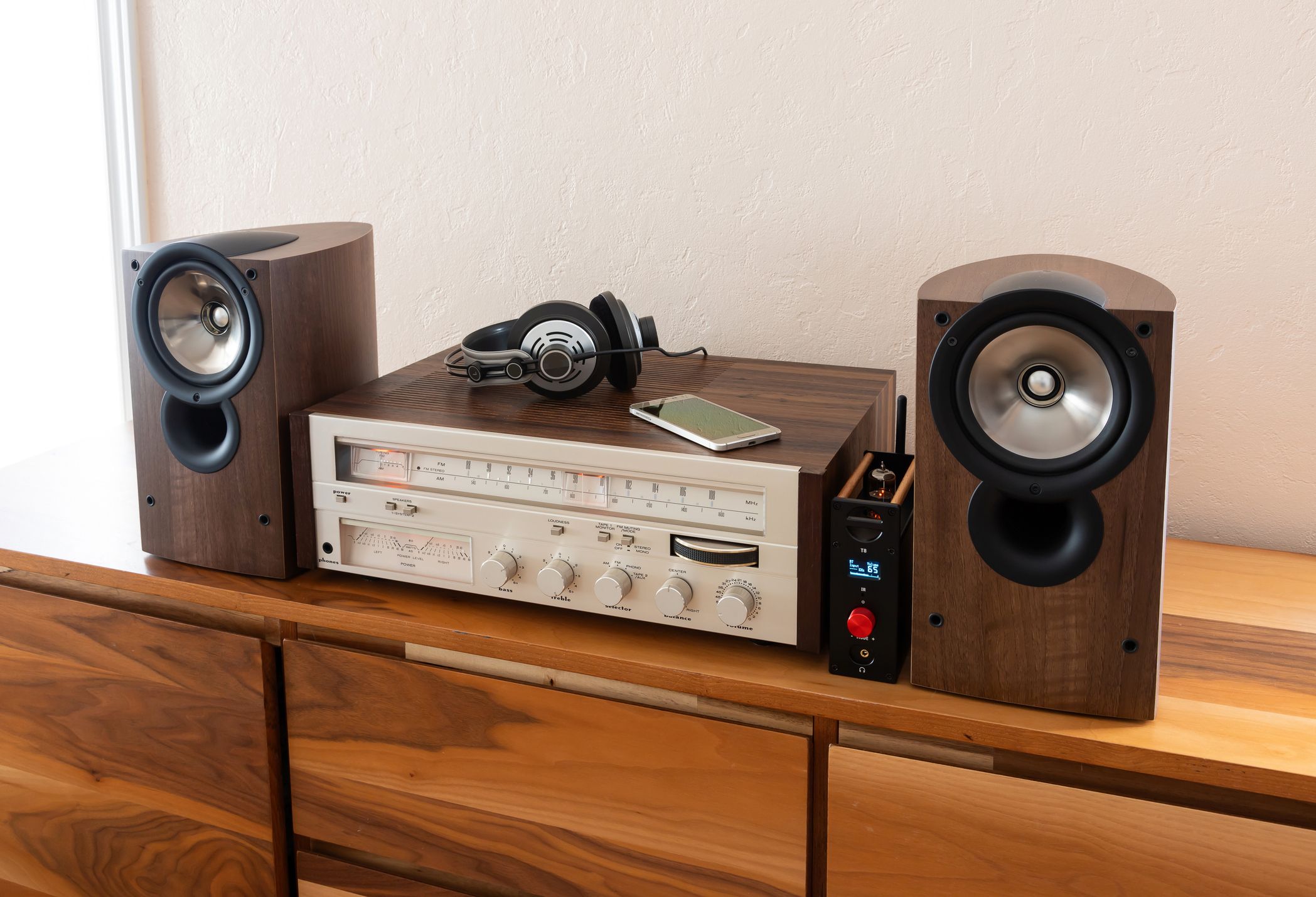
I spied a diamond in the rough at the thrift store. Once upon a time, this Marantz 2220 Receiver was the proud centerpiece of a 1970’s home. But now the thick walnut case was faded and stained. A note warned that its iconic blue tuning dial didn’t light up… or tune in stations, but added optimistically that the amplifier seemed to work.
Why on earth would I pay $225 for an old, broken piece of electronic equipment? Well, vintage stereos are a hot item these days, driven by nostalgia and the revival of vinyl LPs. Hip coffee shops, stores, and restaurants in my neighborhood often display a vintage stereo behind the counter.
A perfectly restored example of this Marantz could command $1,000; the relatively rare walnut-veneered case could be worth the asking price on its own. With a little elbow grease and a few modern add-ons, this machine will be a useful and beautiful addition to my home. Here’s how to do the same for your own sound system.
Article continues below
Sign up for Kiplinger’s Free Newsletters
Profit and prosper with the best of expert advice on investing, taxes, retirement, personal finance and more – straight to your e-mail.
Profit and prosper with the best of expert advice – straight to your e-mail.
That old stereo offers better sound quality
Stereo receivers were, for a long time, the all-in-one hi-fi solution. They combined a radio tuner, a preamplifier to switch between sound sources, and finally, an amplifier for power. Their glowing faces exuded a space-age panache, with a spread of meters and needles bouncing to indicate the amplifier’s output, the strength and the accuracy of incoming radio signals.
These machines evolved into today’s home theater receivers, which positively bristle with connections for many inputs (rarely for turntables), up to seven speakers and a subwoofer or two.
Many people, possibly confused by the need to hook up so many connections, have been scared away from receivers. Instead, most consumers have turned to all-in-one “powered speakers” that connect wirelessly to the internet and attempt to simulate stereo from tiny speakers in a single box.
I find the look of these modern plastic boxes uninspired and their sound even more disappointing. They often have a short lifespan, becoming obsolete as technology changes, and aren’t designed to be repaired when something inevitably goes wrong.

Under the hood of the vintage Marantz receiver.
(Image credit: Benjamin Tice Smith)
Refurbishing an old stereo is easier than you think
After a quick test in the store confirmed some functionality in the Marantz, I took the plunge and bought the system. I refurbished it in only two hours with the following steps.
- With only a Phillips-head screwdriver, I removed it from its case.
- I replaced the burned-out bulbs with a set of replacement LED’s (about $10 from Amazon) that brought back the tuner dial’s famous blue glow.
- Tightening the string on the tuner reconnected the heavy aluminum “Gyro-Touch” tuning wheel and restored its ability to tune in FM stations.
- Spraying all the connections and controls with a cleaner called “DeOxit” eliminated some crackling noise from the controls.
- A little refinishing with steel wool and a finish restorer removed the stains and brought the walnut case back to glory. Be sure to use products like this outdoors or in well-ventilated areas for safety.
While this refurbishment was easy, repairing these systems can be a challenge — and part of their allure. Marantz produced many models, and their enduring popularity means it is easy to find parts (often as kits tailored to specific models, complete with instructions).
More ambitious owners may attempt to fully rebuild their machines. The high prices of used models that have been “recapped” (replacing old capacitors, the electronic components most likely to fail) reflect the labor involved. The way these were built, with individual circuit boards for each separate function, makes tracing faults easier than modern electronics, where problems can more easily hide in miniaturized circuits.

The Marantz system in all its refurbished glory.
(Image credit: Benjamin Tice Smith)
Connecting a vintage system to streaming services
Spinning the heavy tuner knob through the FM dial is a delight. For access to more music, I hooked it up to an inexpensive 1Mii B06+ wireless Audio Adapter, which lets me connect to services such as Apple Music, Spotify and others via my phone’s Bluetooth.
I also connected the Marantz to my home’s Sonos, a more robust (and more expensive) system that draws from a library of music on a hard drive. Sonos also offers online music services through Sonos Radio or other providers like Apple Music, and streams them to all connected stereos in the house via WiFi.

Vintage stereo equipment deserves preservation — and a cool display.
(Image credit: Benjamin Tice Smith)
How to find your own vintage hi-fi
1. Select a brand
Notable manufacturers other than Marantz that sold equipment during the “golden age of high fidelity” included Pioneer, Kenwood, Sansui, and many others. Each has its own distinct, striking industrial design and vocal fanbases. Videos abound that explain how to work on them and compare the virtues of various models and brands. The more collectible models have the most support. Less-appreciated brands and models can be less expensive but more difficult to repair.
2. Pay attention to amplifier ratings
My “new” model is on the lower end of the Marantz lineup, putting out only 20 watts per channel, but amplifier ratings can be confusing. While it would seem like a 20-watt amplifier would be one-tenth as loud as a 200-watt amplifier, it’s actually only half as loud. It will have plenty of power in my kitchen or workshop, as long as I pair it with efficient speakers.
Another advantage of low power (especially in vintage audio) is its simplicity. Higher-powered amplifiers require linking together bigger components, more circuitry, higher voltage, and more heat. This means more things to break, more stress on the parts and when they do break, less room to fix them in a cramped chassis.
In their golden age, competition was fierce, and receivers gained bells and whistles; the top-of-the-line models grew from 100 watts per channel to 330 in five years. Some models even included a small oscilloscope! These models with more gadgets command the highest prices from collectors, partly because they are so expensive to repair, but how useful are they? Many of these gadgets, such as quadraphonic sound and Dolby FM noise reduction, are useless today, and some are unwieldy giants, almost 2 feet wide and weighing more than 75 pounds!
3. Where to buy a vintage receiver
Finding a good unit can be a challenge. Thrift stores and garage sales can very rarely yield gems. Local stores that specialize in vintage stereos, where you can actually listen to and test the unit, are a better option, especially if they offer to service what they sell.
Buying online can be a crapshoot. Shipping delicate old equipment across the country can present challenges (so much so that Skylabs Audio, a dealer and a great source of information on old equipment, recently announced it would only sell vintage gear in its Des Moines, Iowa, store).
Facebook Groups dedicated to vintage brands are a good place to start for advice of all kinds, and can lead to a well-cared-for unit or technical help.
Talking to staff at your local stores that sell used vinyl records and vintage guitar amplifiers is a great way to find a reliable repair person.
Audio boffins will argue endlessly about what gear sounds best, and while many will argue that vintage gear has some unique “warm” sound qualities, what is undeniable is that the look and tactile sensations of a classic receiver are hard to beat: Switches that make a reassuring click when pushed, Meters that seem alive, Brushed aluminum faces bookended by walnut or rosewood panels.
Add some good speakers and, if you held on to your LPs and a turntable, you will be ready to rock for another few decades.
