


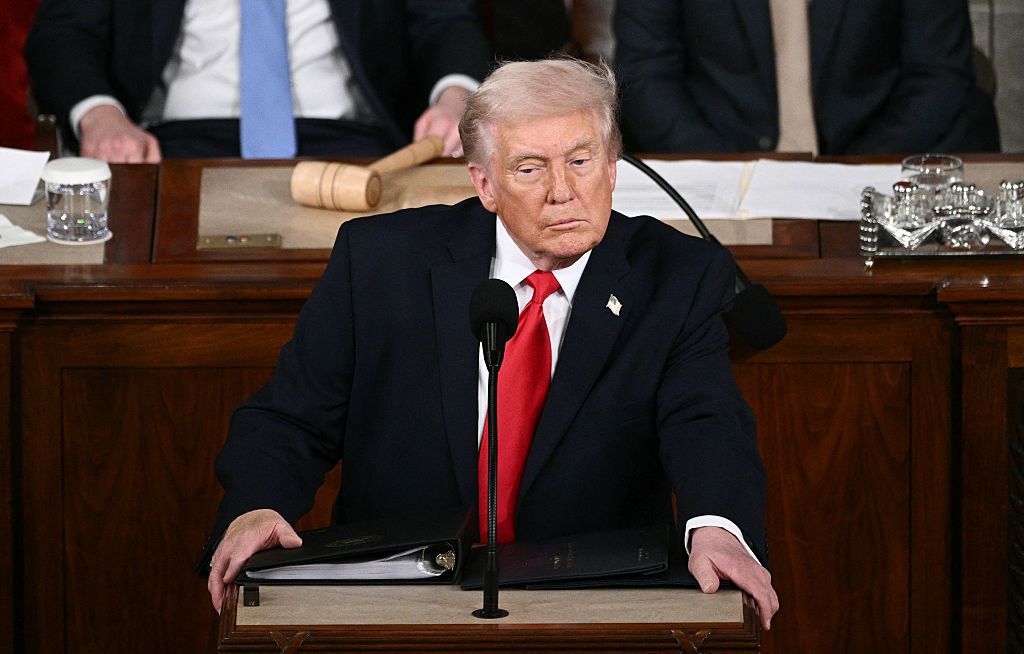

(Image credit: Brendan SMIALOWSKI / AFP via Getty Images)
President Donald Trump delivered his annual State of the Union address to Congress on Tuesday, February 24. At nearly two hours, it set a new record as the longest State of the Union in history. But there was one little nugget that really caught the attention of financial planners … and of the 56 million Americans who currently do not have access to a workplace retirement plan.
Specifically, Trump said he will create a new retirement savings account modeled after the Thrift Savings Plan (TSP) that is currently offered to federal workers. And to top it off, Uncle Sam will offer up to $1,000 in annual matching.
Here’s what the president had to say about the retirement plan:
Sign up for Kiplinger’s Free Newsletters
Profit and prosper with the best of expert advice on investing, taxes, retirement, personal finance and more – straight to your e-mail.
Profit and prosper with the best of expert advice – straight to your e-mail.
[H]alf of all of working Americans still do not have access to a retirement plan with matching contributions from an employer. To remedy this gross disparity, I’m announcing that next year, my administration will give these oft-forgotten American workers – great people, the people that built our country – access to the same type of retirement plan offered to every federal worker.
We will match your contribution with up to $1,000 each year.
And these new plans, according to Trump, “will ensure that all Americans can profit from a rising stock market.”
The details are still a little light. It’s unclear how workers would enroll, whether or not the employers would handle funding and how exactly the matching would come in to play. It’s also not entirely clear where the funding would come from and whether Congress would need to approve it.
But we do know that the program will be modeled on the existing Thrift Savings Plan, which is the public-sector equivalent of a 401(k) plan, and could build on the Saver’s Match Program established by the Biden administration in the SECURE 2.0 Act.
What might these retirement plans look like for future investors?
To get a better understanding of how these new retirement plans might work, we took a closer look at the TSP in its current form to see what information we could glean.
The TSP is the federal government’s version of a 401(k), available to civilian federal employees and uniformed military personnel. Established in 1986 and administered by the Federal Retirement Thrift Investment Board (FRTIB), it has grown into the world’s largest defined contribution plan, with over $1 trillion in assets and roughly 7.2 million participants.
Similar to a 401(k), it comes in both traditional (pre-tax) and Roth (post-tax) flavors.
The plan offers five core individual funds, all passively managed (and extremely inexpensive) index strategies, plus a suite of target-date Lifecycle Funds. The underlying funds are managed by BlackRock Institutional Trust Company and State Street Global Advisors Trust Company, two of the largest ETF managers in the world.
Here’s a breakdown of the funds:
G Fund (Government Securities): Invests in special-issue U.S. Treasury securities created exclusively for the TSP. The G Fund is unique in that it earns long-term Treasury rates with no principal risk.
F Fund (Fixed Income Index): This index fund tracks the Bloomberg U.S. Aggregate Bond Index, covering investment-grade U.S. bonds. The performance should be similar to that of the iShares Core U.S. Aggregate Bond ETF (AGG).
C Fund (Common Stock Index): Tracks the S&P 500. This is the most popular fund by assets and comparable to the iShares Core S&P 500 ETF (IVV) or State Street SPDR S&P 500 ETF Trust (SPY).
S Fund (Small Cap Stock Index): Tracks the Dow Jones U.S. Completion Total Stock Market Index, covering small- and mid-cap stocks not in the S&P 500.
I Fund (International Stock Index): Tracks the MSCI ACWI IMI ex USA ex China ex Hong Kong Index, which was updated in recent years to include more emerging-market exposure. This fund is designed to give broad exposure to stocks that are outside of the U.S.
On top of those five, there are currently 11 Lifecycle (L) Funds – L Income, L 2030, L 2035, up through L 2075 – which are target-date funds that blend the five core funds and automatically shift toward more conservative allocations as the target retirement year approaches.
As for the costs, this is where the TSP genuinely stands out. The C Fund’s 2025 total expense ratio was 0.035%, or just 35 cents per $1,000 invested. As of January 2026, less than 1% of the roughly 170,000 investment funds tracked on FactSet reported expenses below the TSP’s average 2025 total expense ratio.
It’s a solid retirement plan, as good or better than the great majority of corporate 401(k) offerings, and at a rock-bottom price.
Should you invest?
If you don’t already have access to a company 401(k) plan, then the answer is almost certainly yes. At a bare minimum, you should at least invest enough to take advantage of Uncle Sam’s free matching, which Trump indicated would be capped at $1,000 to start.
But it’s important to remember that these accounts, if they come to fruition, won’t likely be available until 2027 at the earliest.
In the meantime, you have options. All American workers already have access to Individual Retirement Accounts (IRAs) and Roth IRAs. For 2026, the IRA contribution limit increases to $7,500 for individuals under age 50, and $8,600 for those age 50 or older.
Your ability to invest in a Roth IRA starts to phase out at a Modified Adjusted Gross Income (MAGI) of $153,000 for single filers and $242,000 for married filing jointly. But if your income is higher and you want to go this route, you can always invest in a traditional IRA and do a Roth conversion.
Of course, if you already invest in a corporate 401(k) or similar plan, that should be your priority. Most offer matching that is more generous than the $1,000 that Trump’s federally funded retirement plans would offer. The average is around 4% of your salary, and the total dollar amount of matching and other employer contributions can be tens of thousands of dollars, depending on your age and income level.
But if you don’t have access to a corporate 401(k), then the new Trump-endorsed retirement plans might be a great option to invest in once they become available.
