



(Image credit: Getty Images)
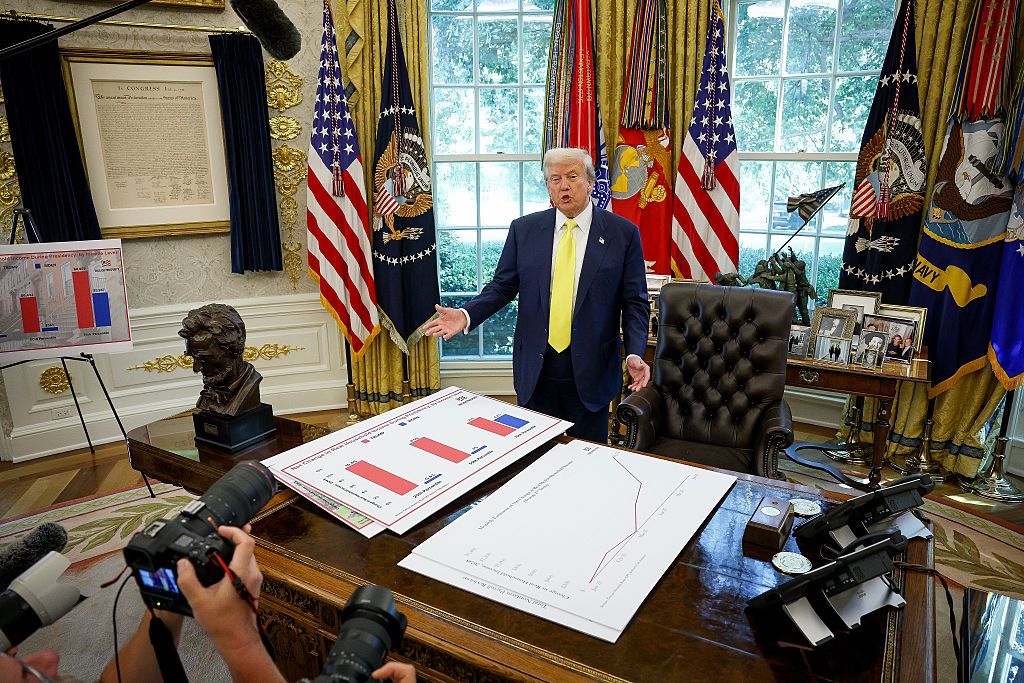
As 2026 kicks off, the “Trump 2.0” economic agenda has moved from campaign promises to portfolio realities. Between trade tensions, the sweeping One Big Beautiful Bill Act (OBBBA) and a new regulatory environment, investors are facing a significantly altered landscape from recent years.
However, before you overhaul your portfolio like a Trump rally, it’s important to maintain perspective.
“History strongly suggests that making wholesale portfolio changes based on the party or person in the White House is unlikely to improve long-term outcomes,” says Bo Ramsey, co-managing partner and chief investment officer at Oxford Financial Group. The U.S. equity market has delivered positive real returns in both Democratic and Republican administrations.
Sign up for Kiplinger’s Free Newsletters
Profit and prosper with the best of expert advice on investing, taxes, retirement, personal finance and more – straight to your e-mail.
Profit and prosper with the best of expert advice – straight to your e-mail.
Ultimately, “economic growth, earnings, inflation and interest rates” are far more “influential than politics,” Ramsey says. As such, for most investors, “the appropriate response is not tactical repositioning,” but rather ensuring your portfolio is “diversified, aligned with your long-term goals and constructed to weather multiple macroeconomic regimes.”
To help you navigate the year ahead, here are the five most critical policy-driven impacts to watch.
1. Trade tensions and the dollar: high volatility may boost foreign assets
President Donald Trump’s stance on global trade has taken protectionism to a whole new level. Tariffs on imports are the highest they’ve been since the 1930s. This contributed to a weakening U.S. dollar in 2025, as large global investors such as central banks moved some reserve assets to foreign nations.
While the U.S. dollar is unlikely to lose its reserve status entirely, Corbin Grillo, a chartered financial analyst and director of Investment Strategy at Linscomb Wealth, suggests taking a close look at your international diversification within the equity sleeve of your portfolio.
“If the U.S. dollar continues to trend lower in the years to come, that is one of several variables that could be a tailwind for the performance of foreign assets,” he says.
The ideal percentage of domestic to international stocks varies by investor, but you can use the fact that the global publicly traded market is roughly 65% U.S. stocks and 35% international stocks as a barometer.
That said, despite the potential for trade news to trigger sharp intra-year swings, such as the equity drawdowns in April 2025, the broader market has proven to be resilient. Ramsey points out that in 2025, the S&P 500 returned approximately 18% despite these “headline risks.”
“For investors, it is important to recognize that tariff-driven volatility is commonly noise rather than a fundamental regime shift,” he says. “As such, we believe investors should maintain broad diversification across geographies and sectors so that idiosyncratic policy developments do not dominate outcomes.”
2. The new Fed: navigating the hunt for yield in a lower-rate environment

(Image credit: Getty Images)
One of the most significant milestones of 2026 is the conclusion of Federal Reserve Chair Jerome Powell’s term in May.
“The Trump administration has made one thing abundantly clear regarding monetary policy: They favor lower interest rates,” Grillo says.
While the Fed chair does not have sole discretion over rates, any new appointee is likely to share the administration’s dovish leanings. Investors should prepare for an environment where cash and money market rates may be less attractive than they have been in recent years, Grillo says.
“This could mean finding alternative ways to generate income in a portfolio,” he adds, like with high-quality bonds and dividend-paying stocks. Just keep in mind the different risks associated with each cash alternative.
3. Tax policy stability: corporate certainty could drive earnings and buybacks
The One Big Beautiful Bill Act, or OBBBA, has been a cornerstone of the administration’s fiscal strategy, extending corporate tax cuts and introducing new incentives. While these policies support earnings, their primary value may be the certainty they provide.
“Uncertainty itself often drives decision-making, even before legislation is passed,” Ramsey explains, noting that corporate stock buybacks historically slow down during uncertainty and accelerate once tax clarity returns.
Because these are largely extensions of existing policies, they may not drastically change the trajectory of corporate earnings, but they do provide a solid floor for long-term returns.
Rather than speculating on marginal tax rate changes, Ramsey emphasizes “tax-aware portfolio construction” and coordinated planning across taxable and tax-advantaged accounts to improve after-tax outcomes over time.
4. Financial deregulation: the “copycat ETF” revolution may lower your fees

(Image credit: Getty Images)
Deregulation has become a key tool for stimulating economic growth, especially in the financial sector. Regulators are easing rules on lending and capital requirements to make it easier for banks to extend credit and for businesses to invest. For investors, though, one of the most consequential changes of deregulation is the so‑called “copycat ETF” revolution.
Regulators have approved multi‑share‑class structures that allow mutual fund firms to launch ETF versions of their flagship active strategies. This will give investors access to the same portfolios with lower fees and greater tax efficiency.
Keep an eye out in 2026 for opportunities to swap older, tax-inefficient mutual funds for these newer, lower-cost “copycat” ETF versions.
5. Energy policy: drilling down on inflationary pressures
The energy sector is also getting a boost from deregulation. The Trump administration is aggressively supporting traditional fossil fuel companies to increase exploration and production. The goal is to keep oil and gas prices stable, which Grillo says should facilitate a “lower inflation environment.”
Deregulation can improve profit margins, but it can also increase competition. Ramsey warns that markets tend to price in these benefits very quickly — often before the actual regulatory changes take effect.
Investors should view sector exposure to energy stocks as “complementary, not dominant,” focusing instead on companies with durable earnings and strong balance sheets.
The bottom line for 2026

(Image credit: Getty Images)
While a new administration can certainly shape how volatile the path of the stock market is in the near term, it rarely changes the market’s long-term trajectory.
“Investing is a long game, and making hasty decisions based on election results can be detrimental to reaching longer-term goals,” Grillo warns.
The most successful investors this year will be those who use the volatility of trade news to rebalance, the “copycat” ETF revolution to lower their costs and remain diversified enough to weather whatever the 2026 policy cycle brings.
