


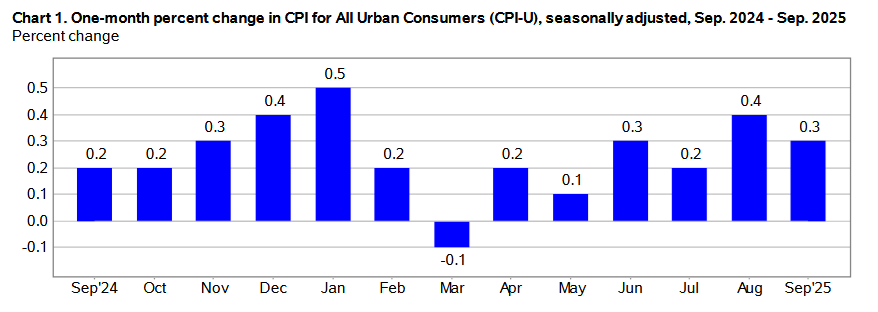
The September 2025 Consumer Price Index of All Urban Consumers (CPI-U) report indicates that inflation increased by 0.3% for the month, down from 0.4% in August. These data were released at 8:30 am EST on October 24, 2025, by the Bureau of Labor Statistics (BLS). Before seasonal adjustment, the year-over-year (Y-o-Y) inflation rate in the all-items index grew by 3.0%, up from 2.9% in August.
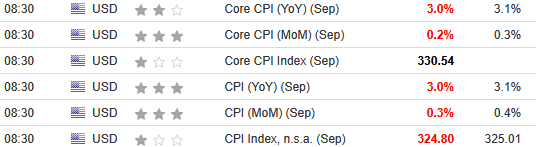
The results missed economists’ consensus estimates. The table below is courtesy of Investing.com. The left column represents September’s figures, while the right column represents forecasters’ expectations. As you can see, the red metrics highlight how inflation was cooler than anticipated.
After cutting interest rates in September, Fed Chairman Jerome Powell noted on Oct. 14 that “Some signs have begun to emerge that liquidity conditions are gradually tightening, including a general firming of repo rates along with more noticeable but temporary pressures on selected dates. The Committee’s plans lay out a deliberately cautious approach to avoid the kind of money market strains experienced in September 2019.”
In other words, with the Fed still selling bonds and liquidity declining in money markets, commercial banks have tapped their reserves to help with short-term funding. The issues could result in the Fed ending quantitative tightening on Oct. 29, which would be another dovish development.
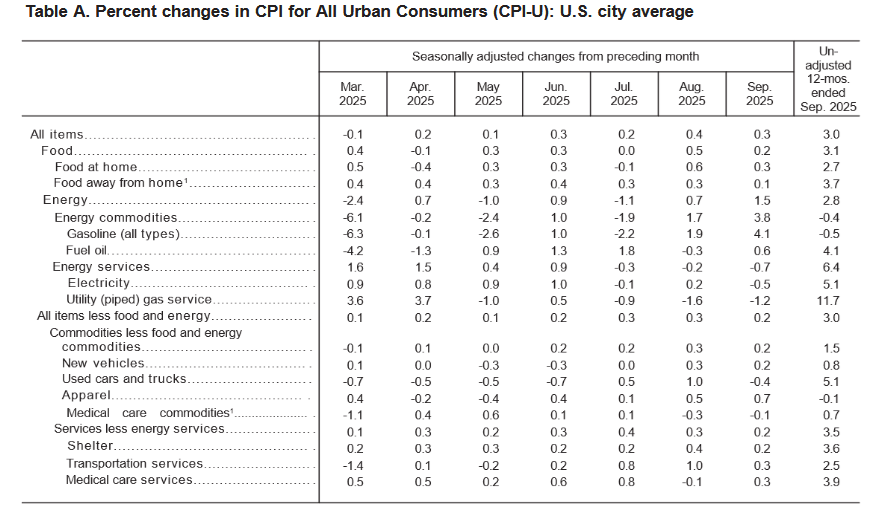
Apparel was the primary outlier in September, rising by 0.7% MoM. Gasoline prices also rose by 4.1% MoM after increasing by 1.9% in August. Core inflation (which excludes the impacts of food and energy), rose by 0.2% in September, slipping from the 0.3% jumps in July and August.
Food Prices
The food index rose by 0.2% MoM in September following a 0.5% rise in August. Four of the six major grocery store food indexes increased, while one was flat, and the other decreased:
- Cereals and bakery products (+0.7%)
- Meats, poultry, fish, and eggs (+0.3%)
- Dairy and related products (-0.5%)
- Fruits and vegetables (+0.0%)
- Nonalcoholic beverages (+0.7%)
- Other food at home (+0.5%)
Surprisingly, the food away from home index rose by 0.1%, which was its lowest reading in several months and signals a slowdown in restaurant inflation.
Energy Prices
The energy index jumped by 1.5% in September following a 0.7% rise in August. Gasoline prices increased by 4.1%, while electricity and natural gas prices fell by 0.5% and 1.2%, respectively.
Core CPI
The September core CPI rose by 0.2% month-over-month and 3.0% Y-o-Y. Below is an itemized breakdown of the main price fluctuations seen in the core CPI reading:
- Shelter index: (+0.2%) [August: +0.4%]
- Rent index: (+0.2%) [August: +0.3%]
- Owners’ equivalent rent: (+0.1%) [August: +0.4%]
- Motor vehicle insurance: (-0.4%) [August: +0.0%]
- Medical care services: (+0.3%) [August: -0.1%]
- Physician services: (-0.1%) [August: +0.3%]
- Hospital services: (+0.3%) [August: +0.0%]
- Airline fares: (+2.7%) [August: +5.9%]
Seasonally Unadjusted CPI
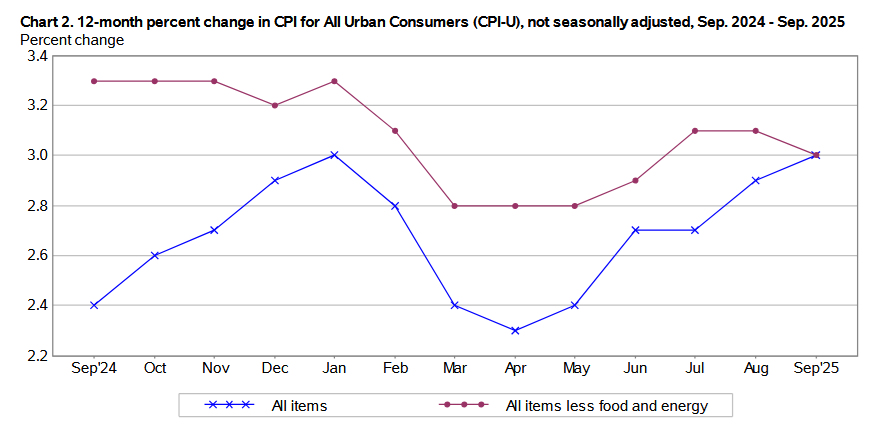
Before seasonal adjustments, the CPI-U for September 2025 increased by 3.0% Y-o-Y to an index level of 324.800. Since these figures are unadjusted, they include regular seasonal price fluctuations that can create volatility in the results.
Economic Challenges
While the U.S. government shutdown has paused the release of most public economic data, private sources still indicate a deteriorating outlook.
For example, there has been a recent string of bankruptcies among large subprime auto lenders, as consumers fail to make their loan payments. An Oct. 17 article from The Guardian noted:
“Car owners were found to be missing payments at the highest rate in more than 30 years in January, when a Fitch Ratings index monitoring the share of subprime auto borrowers at least 60 days past due on their loans hit 6.5%.” In addition: “Car repossessions surged to their highest level since 2009 last year, according to Cox, with 1.73m vehicles seized, up 16% from the year prior and 43% from 2022.”
Moreover, the situation is even worse now. And with interest rates still relatively elevated and stress beginning to show in riskier areas of consumer credit, problems in the auto loan market could spread if the economy continues to weaken.
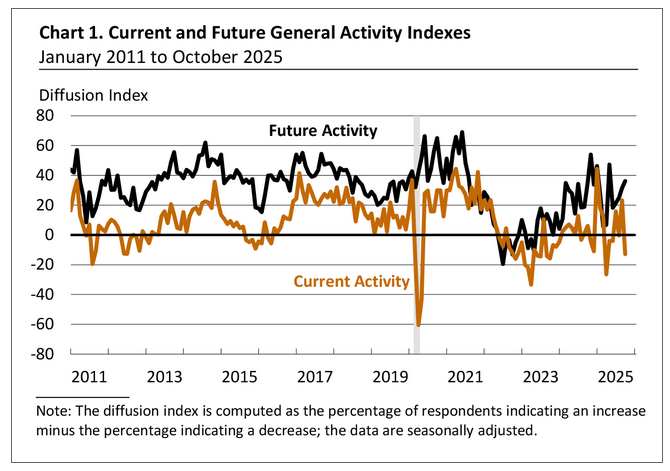
To that point, the Philadelphia Fed released its Manufacturing Business Outlook Survey on Oct. 16. And while sentiment regarding future activity remained positive, “The survey’s index for current general activity fell significantly and turned negative, more than offsetting last month’s increase.”
“The diffusion index for current general activity dropped 36 points to -12.8 in October, its lowest reading since April. Twenty-five percent of the firms reported decreases in general activity this month (up from 17 percent last month), while 12 percent reported increases (down from 40 percent).”
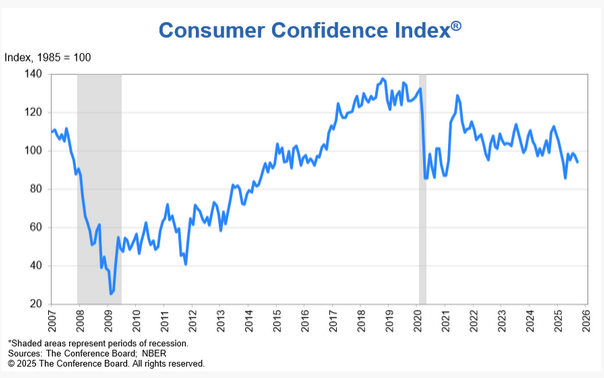
Finally, The Conference Board released its latest Consumer Confidence report on Sep. 30. Stephanie Guichard, Senior Economist, Global Indicators at The Conference Board, said:
“Consumer confidence weakened in September, declining to the lowest level since April 2025. The present situation component registered its largest drop in a year. Consumers’ assessment of business conditions was much less positive than in recent months, while their appraisal of current job availability fell for the ninth straight month to reach a new multiyear low.”
Likewise, “there was a rise in mentions of jobs and employment to a level unseen since August 2024. The comments were mostly negative, especially when referring to the current situation; there were a few positive comments which mostly conveyed hopes that things would get better.”
So, while inflation uncertainty has declined somewhat, the second half of the FOMC’s dual mandate — maximum employment — remains challenged, and could dominate if the recent trends persist. Consequently, lower interest rates may be the path of least resistance until the labor market shows more signs of life.
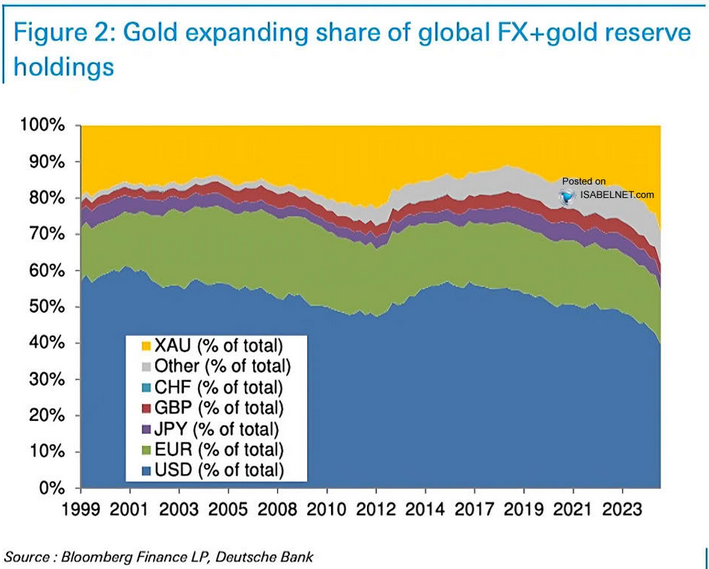
Turning to the financial markets, gold has been on a tear and surpassed $4,000 an ounce. And while volatility has increased, the long-term fundamentals of higher fiscal deficits, inflation, and a weaker U.S. dollar remain in place. Therefore, the theme of global central banks replacing FX reserves with gold should continue for the foreseeable future.
Are you thinking about diversifying into precious metals? Talk to your financial advisor about initiating a gold IRA account today, allowing you to invest in this red-hot asset on a tax-advantaged basis. Additionally, our complimentary CPI inflation calculator remains at your disposal, enabling you to assess inflation’s impact on your finances. Please seek the guidance of a financial advisor before making any investment decision.
Furthermore, if credit concerns have increased alongside the economic uncertainty, there are solutions. TurboDebt is a debt settlement company that negotiates with creditors on your behalf to help lower your financial obligations. The firm focuses on unsecured claims, and you can book a free consultation to determine if the process is right for you.
For tax-related claims, an accredited lawyer can help guide you in the right direction and determine which services fit your needs. Our extensive guide breaks down how the process works and the options available.
Last, if your business is looking for the right financial partner, Grasshopper Bank is a digital institution providing a full suite of products like high-interest savings accounts, low-fee checking accounts, small business administration (SBA) loans, senior secured loans, lines of credit, and other types of commercial loans.
Remember, speaking with a professional ensures the right products are matched with your needs. For more options, please consult our list of debt management firms that can help keep you on track.

Alex Demolitor is a Canadian financial writer hailing from Halifax, NS. Alex has a Bachelors Degree from King’s College and passed the CFA Exam Level III. He specializes in fundamental analysis of the stock, bond, commodity, and FX markets. He also covers US & Canadian economic indicators.
