


- The average rate for an ARM so far this month is 5.51%, compared with a 6.19% average for a 30-year fixed rate mortgage.
- The typical homebuyer using an ARM takes on a monthly payment of $2,578, down 7% from last year.
- Today’s ARM discount is big enough that buyers should talk to their lender about whether it’s the right option for them. ARMs aren’t nearly as risky as they once were; they come with interest-rate caps and protection for borrowers.
The typical homebuyer would save $150 per month taking out an adjustable-rate mortgage instead of a 30-year fixed rate mortgage. That’s a 5.8% discount, the biggest ARM users have had since June 2022 in both dollar and percentage terms.
That’s because the average homebuyer using an ARM so far in March took on a 5.51% rate, while the average buyer taking out a fixed mortgage had a 6.19% rate. The ARM is 0.68 basis points lower– the biggest gap since June 2022.
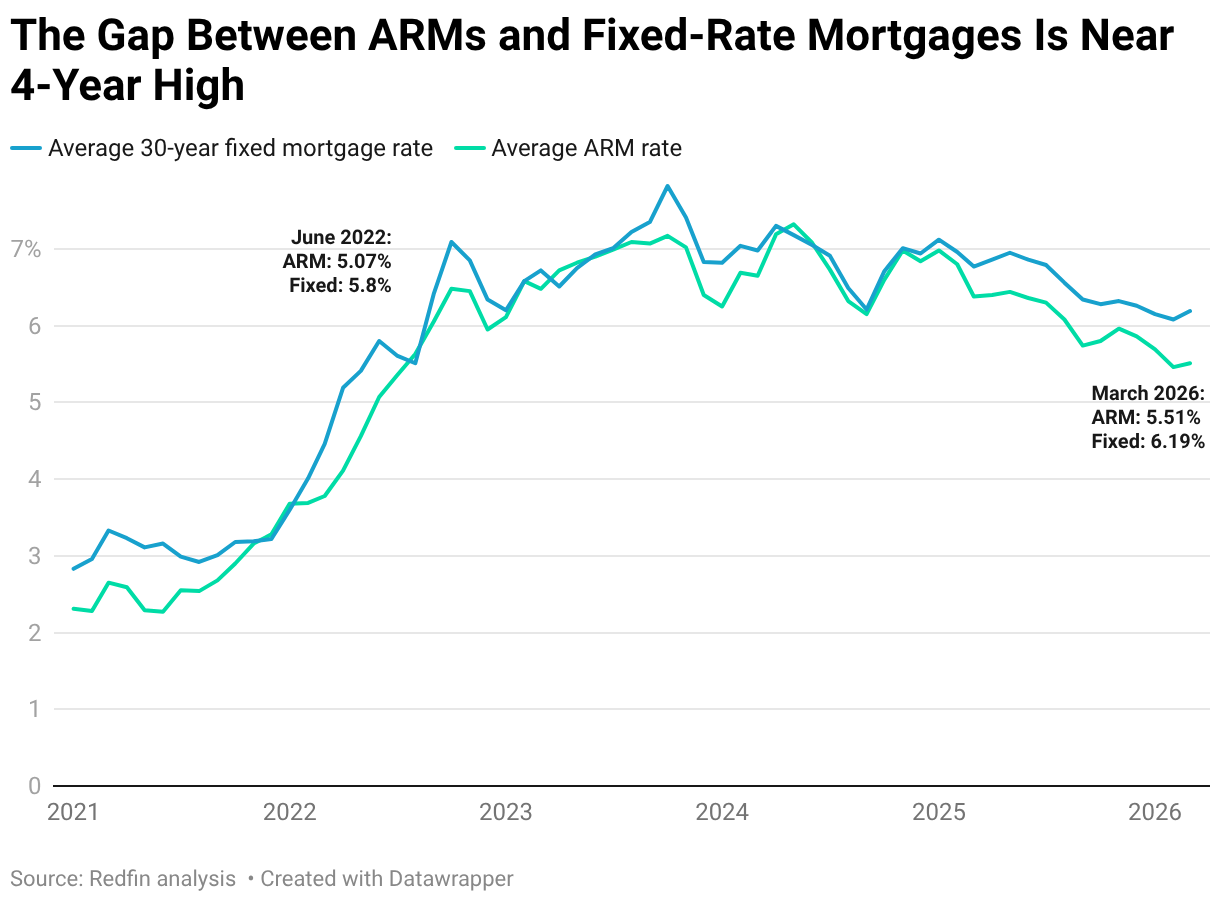
This is according to a Redfin analysis of 30-year fixed mortgage rates compared with 7/6 ARMs as of March 16, 2026. Please see the end of this report for more on methodology.
The typical monthly payment for a homebuyer using an ARM is $2,578, versus $2,727 for someone using a fixed rate.
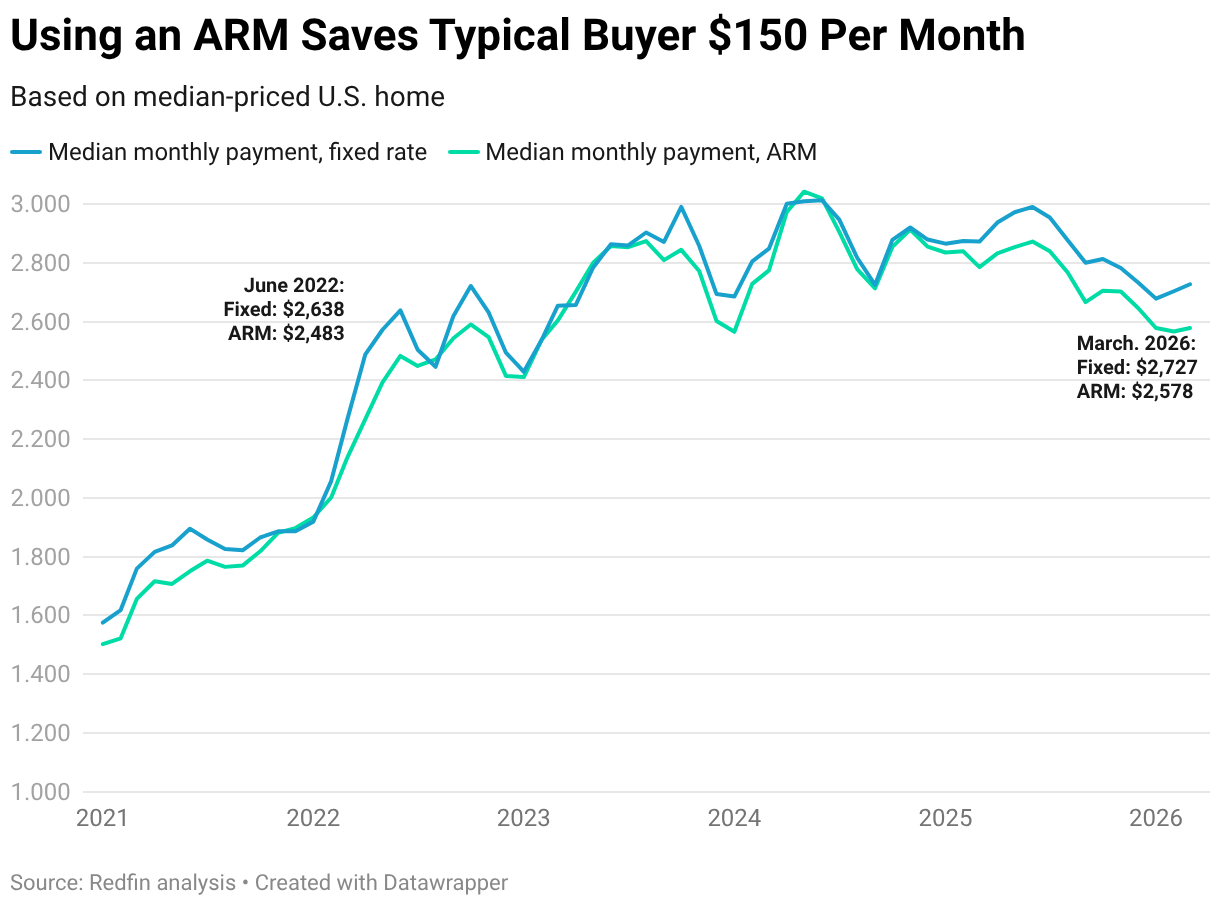
The Typical ARM Buyer’s Housing Payment Is 7% Lower Than a Year Ago
Today’s payment for buyers using an ARM, $2,578, is down 7.4% from a year ago. That’s compared with a 5% decline for fixed-rate borrowers, to $2,727.
Overall, mortgage rates are lower than they were a year ago, bringing homebuyers a bit of relief. But rates for ARMS have declined more: Today’s average rate for an ARM, 5.51%, is down from 6.38% a year ago; the average 30-year fixed rate of 6.19% is down from 6.77%.
“Adjustable-rate mortgages are offering meaningful savings in 2026’s expensive housing market,” said Bill Banfield, chief business officer at Rocket. “Even though housing costs have recently come down a bit, it remains tough for first-time buyers to break in–and for existing homeowners to walk away from their ultra-low rates. With ARMs providing borrowers with the biggest discount in nearly four years, choosing an ARM could be a gamechanger, saving buyers hundreds of dollars each month and thousands over a few years. ARMs typically make sense when rates are high enough that buyers don’t want to lock them in–like now. When rates are low, like they were during the pandemic, it’s worth locking them in for as long as possible.”
The benefit of a 30-year fixed rate mortgage, even when rates are fairly high, is that borrowers know exactly what their payment will be for the entire length of the loan. In today’s market, ARMs are offering lower payments during the initial period, but they come with some uncertainty. After the initial fixed-rate period, rates may be higher, pushing up monthly payments. Of course, rates could also be lower when the seven-year period ends.
ARMs Aren’t As Risky As They Used to Be
The ARM discount is big enough that buyers taking out a mortgage should talk to their lender about whether it’s a good option. ARMs can be a smart strategy for borrowers who plan to stay in a home only for the short term, have the financial means to afford a higher payment and/or plan to refinance their loan later. There’s a fairly good chance rates will fall enough during the fixed-rate period that it makes sense to refinance.
It’s also important for homebuyers to know that ARMs are not nearly as risky as they once were; new rules went into effect after the financial crisis to protect borrowers. One, ARMs come with interest-rate caps, which limit how much the rate can increase each term and over the life of the loan. Two, borrowers often have to qualify for an ARM based on a higher rate, so they typically have leftover room in their budget if the rate does increase. Also note that the typical mortgage lasts between four and seven years before the borrower refinances or sells, according to the National Mortgage Database; often, a homebuyer who takes on an ARM with a seven- or 10-year fixed rate period never even gets to the adjustable-rate period.
Here’s more info on ARMs and 30-year fixed rate mortgages from Rocket Mortgage.
Methodology
This is according to a Redfin analysis of Mortgage News Daily’s rates aggregated to a monthly average: 30-year fixed mortgage rates compared with 7/6 ARMs as of March 16, 2026.
With a 7/6 ARM, the borrower pays a fixed interest rate for the first 7 years of the loan. In the period that follows, the borrower’s interest rate adjusts every 6 months; For this report, monthly payments reflect the initial fixed-rate period (7 years), calculated using a 30-year amortization at the initial ARM rate. After the initial period, the rate adjusts based on an index rate (a market-based reference interest rate) and a margin (a number set by your lender when you take out the loan); it does not adjust directly to a current prevailing mortgage rate. The index (often SOFR) moves with the market, and the lender adds a fixed margin set in the loan terms. ARMs typically have periodic and lifetime caps that limit how much they can increase, both per term and over the life of a loan.
Total monthly housing payments are calculated using median U.S. home sale prices, and assume a 20% down payment, 1.25% property taxes and 0.5% homeowners insurance.
