


- Florida dominates the list of most common migration destinations. Boise and Spokane are also popular.
- But movement into Florida has slowed significantly since the pandemic boom.
- Homebuyers are leaving big-city job hubs like Los Angeles and New York. They’re also moving away from the Bay Area, but that’s not nearly as common as it was during the remote-work heyday.
- In a pandemic boomerang, people are flowing out of Austin, with Los Angeles as their most popular destination.
Just under one in five (18.8%) house hunters looked to move to a different part of the country in the fourth quarter. That’s up slightly from 17.9% a year earlier and up from 15.9% about five years earlier.
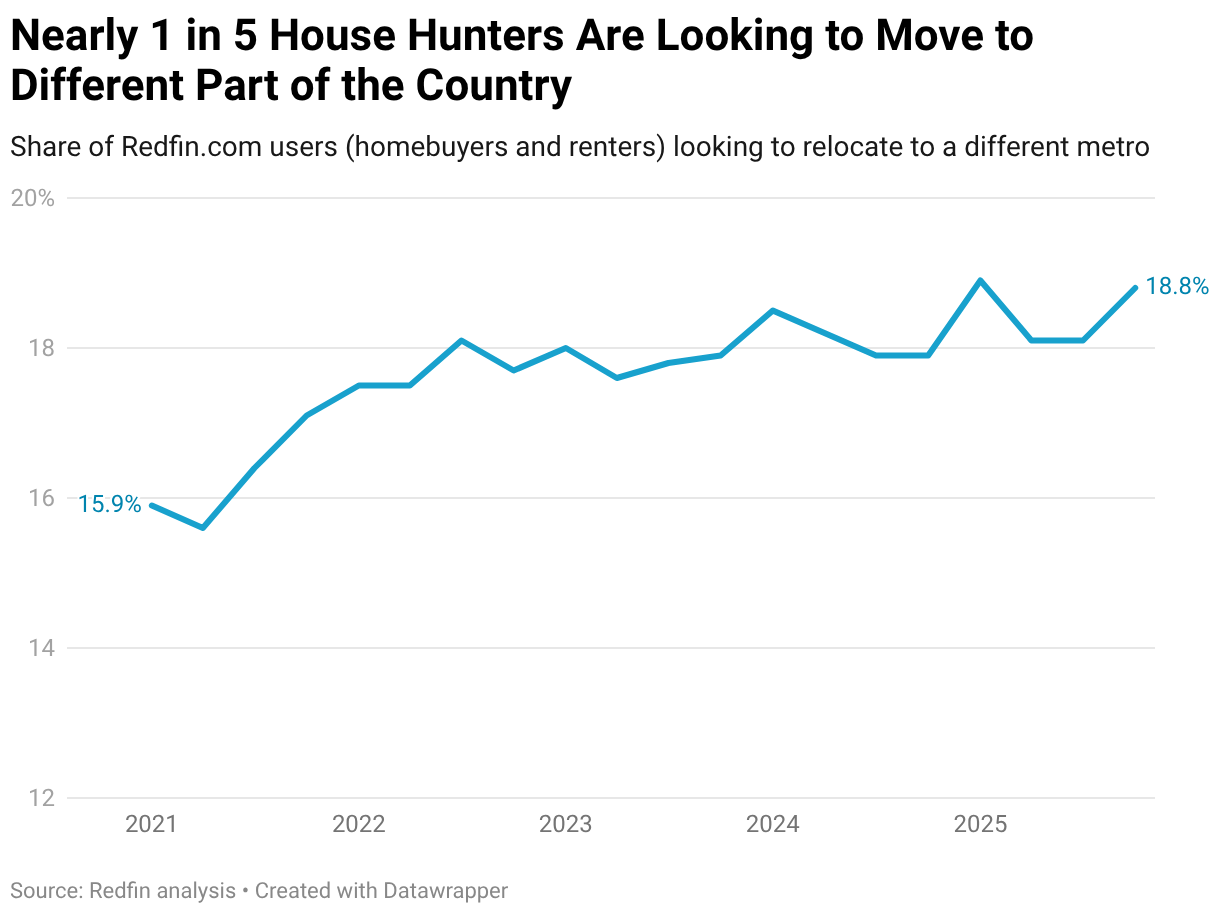
This is from a Redfin analysis of Redfin.com homebuyers and renters searching outside their home metro area. A Redfin.com user counts as a migrant if they viewed at least 20 for-sale homes in an origin-destination pair in the relevant month. Please see the end of this report for more on methodology.
Migration from one part of the country to another ticked up in 2025 as mortgage rates eased and more homes came on the market. While home sales were still slow, more buyers and renters were able to relocate. Remote work also remains more common than it was before the pandemic, allowing more Americans to relocate for affordability or lifestyle reasons without changing jobs.
“People are moving to Tennessee in droves–especially Nashville and its surrounding areas,” said Aaron Glicken, a Redfin Premier agent in Nashville, TN. “Compared to the West Coast, where many of them are moving from, we have relatively low housing costs and lower taxes. A lot of the people moving here work remotely, while others take local tech, healthcare or music jobs. In one exclusive high-end neighborhood, more than half of the homeowners are from California. I had one listing where three neighboring homes were all bought by people moving in from California within the last 18 months.”
Glicken said that while most people relocating to the Nashville area come from California, there are also people moving in from Chicago, New York and Texas.
In 2021, mortgage rates were hovering just under 3% for most of the year and pandemic-fueled remote work was common, driving many people to relocate. While it’s somewhat counterintuitive that a higher share of house hunters are relocating to a different metro now than back then–18.8% compared with 15.9%–Redfin economists say it’s largely due to the large size of the metros in this analysis.
We use Combined Statistical Areas (CSAs), which are typically made up of several Metropolitan Statistical Areas (MSAs). The San Jose-San Francisco CSA, for example, is made up of many surrounding MSAs, including Napa Valley, Santa Cruz and several other places. A remote worker who moved from the city of San Francisco to Napa Valley in 2021 wouldn’t have been considered a “relocator” because those two places are part of the same CSA. That type of move, from cities to suburbs and exurbs, was common during the pandemic.
Sacramento, Las Vegas, Florida Top List of Most Popular Destinations
Sacramento, CA and Las Vegas were the most popular destinations for relocating house hunters in the fourth quarter. Popularity is determined by net inflow, a measure of how many more Redfin.com users looked to move into an area than leave.
Next come four Florida metro areas: Cape Coral, North Port, Miami and Orlando. All 10 of the most popular migration destinations are relatively affordable, especially compared to the places people are most commonly leaving. For instance, the typical home in Las Vegas sells for $435,000, while the typical home in Los Angeles costs twice as much. Additionally, most of the most popular destinations have warm, sunny weather.
| Top 10 Metros Homebuyers Are Moving Into, Q4 2025
Ranked by net inflow of Redfin.com home searchers Top 100 U.S. metros |
||||
| Rank | Metro area | Net inflow | Top origin | Top out-of-state origin |
| 1 | Sacramento, CA | 4,268 | San Francisco, CA | Seattle, WA |
| 2 | Las Vegas, NV | 4,160 | Los Angeles, CA | Los Angeles, CA |
| 3 | Cape Coral-Fort Myers, FL | 4,098 | Chicago, IL | Chicago, IL |
| 4 | North Port-Sarasota, FL | 4,008 | Chicago, IL | Chicago, IL |
| 5 | Miami, FL | 3,878 | New York, NY | New York, NY |
| 6 | Orlando, FL | 3,759 | Miami, FL | New York, NY |
| 7 | Spokane, WA | 2,924 | Seattle, WA | Los Angeles, CA |
| 8 | Boise, ID | 2,923 | Los Angeles, CA | Los Angeles, CA |
| 9 | Myrtle Beach, SC | 2,665 | Washington, D.C. | Washington, D.C. |
| 10 | San Antonio, TX | 2,457 | Los Angeles, CA | Los Angeles, CA |
Florida is home to the lion’s share of the top 10 most popular migration destinations, but movement into the Sunshine State has slowed over the last several years as the pandemic moving frenzy wanes. Inflow into both Miami and Orlando has cooled significantly since the boomtimes of 2021 and 2022, when many remote workers flowed into those cities from places like New York and Boston.

People Are Leaving Big-City Job Hubs Behind
House hunters are leaving Los Angeles and New York more than any other major metro. That’s based on net outflow, a measure of how many more Redfin.com users are looking to leave a metro than move in.
Next come three other major job centers: The Bay Area, Seattle and Chicago. It’s typical for expensive coastal cities and employment hubs to top the list of places people are moving away from, as people seek more affordable housing. Homebuyers leaving New York, for instance, often seek out Philadelphia, where buying a home costs less than half the price.
Homebuyers and renters are also moving away from a few places that don’t fit into the category of big-city job centers: Charlotte, NC and Austin, TX. Those places both attracted a lot of new residents during the pandemic remote-work era, and now some of those people are moving away as they return to the office; Los Angeles is the top out-of-state destination for those moving away from Austin. Additionally, the migration boom and its accompanying uptick in home prices and congestion is driving some locals away.
| Top 10 Metros Homebuyers Are Leaving, Q4 2025
Ranked by net outflow of Redfin.com home searchers |
||||
| Rank | Metro area | Net outflow | Top destination | Top out-of-state destination |
| 1 | Los Angeles, CA | -25,908 | San Diego, CA | Las Vegas, NV |
| 2 | New York, NY | -23,080 | Philadelphia, PA | Philadelphia, PA |
| 3 | San Jose-San Francisco, CA | -21,230 | Sacramento, CA | Seattle, WA |
| 4 | Seattle, WA | -19,154 | Portland, OR | Portland, OR |
| 5 | Chicago, IL | -13,218 | Milwaukee, WI | Milwaukee, WI |
| 6 | Washington, D.C. | -13,080 | Salisbury, MD | Salisbury, MD |
| 7 | Boston, MA | -5,543 | Portland, ME | Portland, ME |
| 8 | Denver, CO | -4,457 | Colorado Springs, CO | Phoenix, AZ |
| 9 | Charlotte, NC | -1,553 | Greensboro, NC | Greenville, SC |
| 10 | Austin, TX | -969 | San Antonio, TX | Los Angeles, CA |
While the Bay Area is still number three on the list of places house hunters are leaving, outbound migration from San Jose and San Francisco has slowed significantly since it peaked in 2021 and 2022. Return-to-office policies and a rebounding tech job market–particularly in the A.I. sector–have tethered more workers to the Bay Area, and slowing home-price growth has left fewer homebuyers feeling the urgency to cash out.

Migration from the Bay Area to Austin, for example, has plummeted: More than 20,000 people looked to move from the Bay Area to Austin in 2021, while just 2,900 looked to move in 2025. Half as many home searchers looked to relocate from the Bay Area to both Raleigh, NC and Charlotte in 2025 as in 2021.
Florida Is Still Top State For Relocating House Hunters, Despite Declining Inflow
Zooming out to the state level, Florida was the most popular destination for relocating house hunters in the fourth quarter. Even though migration into several Florida metros is slowing, the Sunshine state still attracts twice as many Redfin.com home searchers as either South Carolina and Arizona, the second- and third-most popular states, respectively.
Next come four other Sun Belt states: Nevada, Tennessee, Texas and North Carolina. Idaho, Hawaii and Wisconsin round out the top 10.
| State-Level Summary, Q4 2025: Top 10 States Homebuyers Are Moving Into
Ranked by net inflow of Redfin.com home searchers |
||
| Rank | State | Net inflow |
| 1 | Florida | 34,381 |
| 2 | South Carolina | 17,651 |
| 3 | Arizona | 16,330 |
| 4 | Nevada | 14,714 |
| 5 | Tennessee | 13,500 |
| 6 | Texas | 11,604 |
| 7 | North Carolina | 9,235 |
| 8 | Idaho | 8,126 |
| 9 | Hawaii | 7,532 |
| 10 | Wisconsin | 7,208 |
People are leaving California more than any other state by a longshot. That remains the case even though far fewer people are leaving the Bay Area for other U.S. metros than during the pandemic.
Next come four other states that are home to big job centers: New York, Illinois, Washington and Massachusetts.
| State-Level Summary, Q4 2025: Top 10 States Homebuyers Are Leaving
Ranked by net outflow of Redfin.com home searchers |
|
| State | Net outflow |
| California | -84,593 |
| New York | -34,005 |
| Illinois | -29,336 |
| Washington | -24,666 |
| Massachusetts | -14,766 |
| Virginia | -10,031 |
| Colorado | -3,747 |
| Washington, D.C. | -3,551 |
| Maryland | -1,991 |
| Minnesota | -905 |
Methodology
This is from a Redfin analysis of Redfin.com users–both homebuyers and renters–searching outside their home metro area.
Our migration analysis is based on Redfin.com users searching for homes across more than 100 metro areas in the U.S. For this analysis, a metro area is defined at the Combined Statistical Area (CSA) level, which include multiple Metropolitan Statistical Areas (MSAs). The analysis is from January 2021 to December 2025.
We identify potential migrants as users who search for homes outside their current metro area. A Redfin.com user must view at least 20 for-sale or for-rent homes in a destination metro during a one-month period to be counted as looking to relocate there.
If a user views homes in multiple metros, we proportionally allocate their migration based on search activity. For example, if a Seattle-based user views 40 homes—20 in Phoenix and 20 in San Diego—they count as half a migrant to Phoenix and half to San Diego. This approach allows us to measure both the volume and direction of migration interest across the country.
