


- Homeowner tenure peaked at 13.4 years in 2020, roughly doubling the average tenure from 2005. Then it declined marginally for four years before ticking up in 2025.
- People hanging onto their houses can be an obstacle for first-time homebuyers because it limits inventory and pushes up prices.
- Tenure is longest in California, largely because state tax laws incentivize homeowners to stay put. In Los Angeles, the typical homeowner hangs onto their house for 20 years, followed by San Jose, where it’s nearly 19 years.
- Tenure is shortest in relatively affordable metros, led by Louisville and Las Vegas.
The typical U.S. homeowner stays put in their house for 12 years, the longest median tenure since 2022.
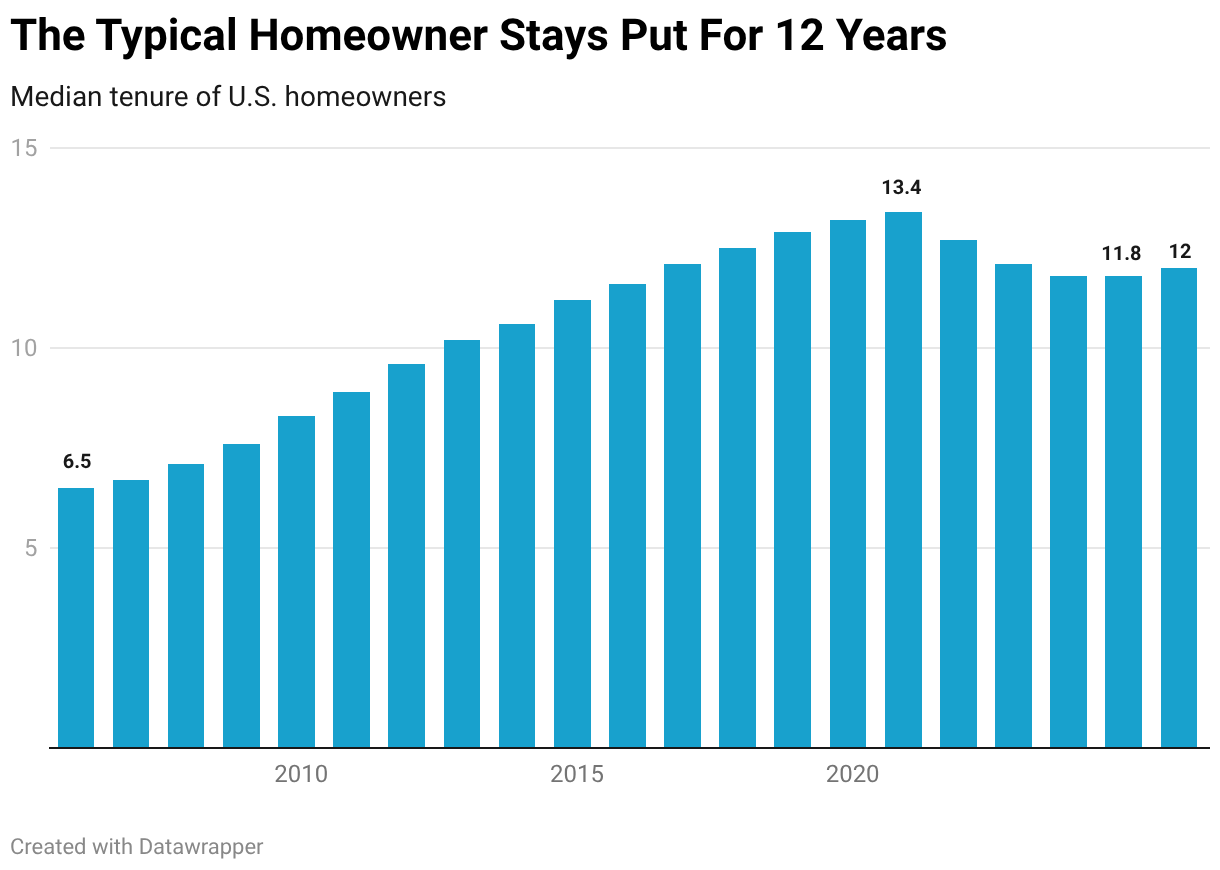
This data is from a Redfin analysis of median homeowner tenure by year in the U.S. as of 2025, using historical county records. The data in this report goes back through 2005. Tenure for 2025 is defined as the number of years between the most recent sale date of a home and December 1, 2025.
Homeowner tenure peaked at 13.4 years in 2020, then gradually declined each year until 2024. The declines were driven by the pandemic-driven homebuying and selling frenzy, when record-low mortgage rates and remote work motivated many Americans to move. Tenure inched up from 11.8 years in 2024 to 12 years in 2025 as home sales slowed due to high housing costs.
Still, homeowners are holding onto their houses for nearly twice as long as they were in the early aughts. In 2005, for instance, the typical homeowner stayed put for 6.5 years before selling. Over the next decade-plus, people stayed in their homes longer as the American population grew older. Baby boomers and Gen Xers became increasingly likely to age in place because they’re financially incentivized to stay put–many older people own their homes free and clear, and those who do have a mortgage likely have a much smaller payment than a homebuyer would today. Older people also typically have less reason than younger people to relocate; for instance, they’re not as likely to move for a new job or grow their families.
Homeowners hanging onto their houses for a long time can be an obstacle for first-time homebuyers. A 2024 Redfin analysis found that empty-nest baby boomers own 28% of America’s three-bedroom-plus homes, twice as many as millennials with kids. While it’s understandable that older Americans want to hold onto their low housing payments–or no housing payment–the flip side is that it depletes inventory of starter homes and pushes home prices higher.
“High mortgage rates and home prices perpetuate a cycle that locks up housing inventory,” said Chen Zhao, Redfin’s head of economics research. “It can keep existing homeowners in place and financially discourage them from moving to a different home or a different neighborhood, which drives prices up even higher for first-timers trying to break into the market. But there is good news: Homebuying affordability has improved as mortgage rates have come down, dropping below 6% for the first time in over three years last week. And home-price growth has lost steam, and we expect it to improve more. That should push more Americans to move.”
California Homeowners Stay Put Longest, Led By Los Angeles
Los Angeles homeowners typically hang onto their homes for 20 years–the longest span in the nation. Los Angeles is also the metro with the biggest annual uptick in tenure: 20 years in 2025, up from 19.4 years in 2024.
It’s followed by another major California metro, San Jose, where homeowners stay put for an average of 18.7 years. Homeowners in San Francisco (16.5 years), San Diego (14.5 years) and Riverside (12.4 years) also hang onto their homes longer than the national average.
California’s tax laws incentivize homeowners to stay in their homes for a long time. Proposition 13, which was adopted in 1978, locks owners into low property taxes, discouraging them from moving and taking on a higher tax rate. Lifelong low property taxes keep bills low for homeowners, but they can limit the supply of homes for sale and push up prices, making it tougher for first-timers to break into the market.
There have been tax amendments in recent years, like Proposition 19, designed to incentivize longtime homeowners to move. But their impact has been limited.
Relatively Affordable Metros, Vacation Destinations Have the Quickest Home Turnover
Homeowner tenure is shortest in Louisville, KY, where the typical owner spends 8.3 years in their house before selling. It’s followed by Las Vegas (8.8 years), Charlotte, NC (9.2 years), Orlando, FL (9.2 years) and Raleigh, NC (9.3 years).
Tenure is shortest in those places partly because homes are affordable compared to many other parts of the U.S. When home prices are lower, it’s typically easier for homeowners to sell and move on because they’re not taking on an ultra-high mortgage payment on their next house. Another reason why tenure is relatively short in Las Vegas and Orlando: They’re vacation destinations, which means people may move in and out for short-term employment opportunities. Investors are also pulling back from Las Vegas and Orlando, which means some of them are selling homes and contributing to turnover.
Tenure Rose in Most U.S. Metros From 2024 to 2025
Homeowner tenure increased in 28 of the 41 metros in this analysis from 2024 to 2025, led by Los Angeles, Denver and Raleigh, NC.
It stayed the same in one metro (Richmond, VA), and declined in 12, with the biggest drops in Chicago, Memphis, TN and Baltimore.
| Metro-Level Summary: Homeowner Tenure
41 most populous CBSAs in the U.S. In order from longest median tenure to shortest |
|||||
| U.S. metro area | Median tenure, 2025 (in years) | Median tenure change, 2024 to 2025 (in years) | Median tenure change, 2015 to 2025 (in years) | Median home-sale price | Median home-sale price, YoY |
| Los Angeles, CA | 20.0 | 0.6 | 5.0 | $890,000 | -1.7% |
| San Jose, CA | 18.7 | 0.4 | 4.8 | $1,430,000 | -3.9% |
| Cleveland, OH | 17.8 | 0.2 | 2.9 | $230,000 | 0.0% |
| Providence, RI | 17.4 | 0.5 | 5.8 | $500,000 | 4.4% |
| San Francisco, CA | 16.5 | -0.3 | 3.4 | $1,449,000 | 3.5% |
| New Orleans, LA | 16.1 | 0.3 | 4.1 | $289,900 | 1.7% |
| Philadelphia, PA | 16.0 | -0.1 | 2.6 | $285,000 | 1.8% |
| Memphis, TN | 15.8 | -0.6 | 1.7 | $288,000 | 6.7% |
| Pittsburgh, PA | 15.7 | 0.2 | 2.2 | $240,000 | 5.3% |
| Richmond, VA | 15.5 | 0.0 | 2.5 | $395,000 | -1.8% |
| New York, NY | 15.0 | -0.1 | 1.9 | $780,000 | 5.4% |
| Baltimore, MD | 14.7 | -0.5 | 1.8 | $395,500 | 2.7% |
| San Diego, CA | 14.5 | -0.1 | 1.3 | $899,500 | 2.2% |
| Hartford, CT | 13.6 | 0.1 | 2.5 | $375,000 | 4.2% |
| Chicago, IL | 13.6 | -0.9 | 1.3 | $355,000 | 4.4% |
| Washington, DC | 13.2 | -0.1 | 1.0 | $571,683 | 3.9% |
| Seattle, WA | 12.9 | -0.2 | 1.6 | $790,000 | 0.1% |
| Cincinnati, OH | 12.7 | -0.1 | 0.4 | $302,674 | 5.6% |
| Detroit, MI | 12.5 | -0.1 | -0.4 | $195,000 | 8.9% |
| Riverside, CA | 12.4 | 0.3 | 0.5 | $585,000 | 0.0% |
| Buffalo, NY | 12.4 | 0.3 | 2.5 | $269,900 | 7.6% |
| Portland, OR | 12.0 | 0.4 | 1.0 | $545,000 | 1.2% |
| Sacramento, CA | 12.0 | 0.4 | -0.2 | $565,000 | -3.4% |
| Miami, FL | 11.9 | 0.3 | -0.4 | $550,000 | -4.0% |
| Oklahoma City, OK | 11.5 | 0.1 | 0.8 | $265,000 | 2.5% |
| Columbus, OH | 11.4 | 0.1 | -1.1 | $340,000 | 3.0% |
| Virginia Beach, VA | 11.3 | -0.2 | -0.6 | $365,000 | 2.8% |
| Milwaukee, WI | 11.2 | 0.1 | 0.2 | $330,000 | 3.1% |
| Minneapolis, MN | 10.6 | 0.2 | -0.9 | $383,000 | 2.1% |
| Denver, CO | 10.2 | 0.6 | -0.4 | $569,999 | -0.9% |
| Jacksonville, FL | 10.0 | 0.2 | -2.2 | $370,000 | -2.6% |
| Birmingham, AL | 9.7 | 0.1 | -1.4 | $291,000 | 0.4% |
| Phoenix, AZ | 9.5 | 0.4 | -1.2 | $469,000 | 0.9% |
| Atlanta, GA | 9.5 | 0.3 | -2.1 | $385,000 | -2.3% |
| Tampa, FL | 9.5 | 0.3 | -2.1 | $385,000 | 1.3% |
| Nashville, TN | 9.3 | 0.5 | -0.6 | $460,000 | 0.0% |
| Raleigh, NC | 9.3 | 0.5 | -1.0 | $425,000 | -3.1% |
| Orlando, FL | 9.2 | 0.4 | -2.1 | $400,000 | -1.2% |
| Charlotte, NC | 9.2 | 0.4 | -1.6 | $410,000 | 3.8% |
| Las Vegas, NV | 8.8 | 0.4 | -2.0 | $445,000 | 1.4% |
| Louisville, KY | 8.3 | 0.4 | 2.2 | $276,250 | 5.3% |
