


Let’s start by setting the context for today’s CPI number.
A couple of months ago, we missed a CPI because of the shutdown. The BLS simply didn’t have any data to calculate the October 2025 CPI. That wasn’t the real problem. The real problem was that the BLS’s handbook of methods more or less forced it, in calculating the November CPI index, to assume unchanged prices for October for some large categories – in particular, rents. This caused a large, illusory decline in y/y inflation figures. Importantly, this was also temporary – there has been some catch-up but the big one comes in a few months when the OER rent survey rotation will cause a large offsetting jump in that category, exactly six months after the illusory dip. Until then, inflation numbers will be more difficult to interpret and the year-over-year numbers will be simply wrong. So when you read that today’s figure resulted in the “smallest y/y change in core inflation since 2021, and consistent with the Fed reaching its target” – that’s just wrong. The true core y/y number is roughly 0.25%-0.3% higher than what printed today. The CPI ‘fixings’ market is currently pricing headline CPI y/y to rise to 2.82% four months from now, and that isn’t because of a coming rebound in energy prices.
I guess what I am saying is this:
Ladies and gentlemen, please take your seats. We will be experiencing some mild turbulence.
January, in general, is already a difficult month in CPI land because of the tendency for vendors of products and services to offer discounts in December and then implement annual price increases in January. But those price increases are not systematic, which means they are difficult to seasonally-adjust for. Ergo, January misses are rather the norm.
So with that context, the consensus estimates for today’s number were for +0.27% m/m on the headline CPI, and +0.31% on core. Some prognosticators were quite a bit higher than that – I think Barclays expected +0.39% on core CPI. The question was basically whether there is still any tariff increase that needs to be passed through; if so then January is a good time to do it. That didn’t really happen. The actual print was +0.17% on headline and +0.30% on core.
The miss on headline happened because while gasoline prices actually rose in January, the average price in January was lower than the average price in December – because in December, gasoline prices dropped sharply. While Jan 31 gas versus Dec 31 gas was $2.87 vs $2.833 (source AAA), January 1 vs December 1 was $2.83 vs $2.998. So, even though gasoline prices rose over the course of January compared to the end of December, that’s now how the BLS samples prices.
Be that as it may, core inflation was pretty close to target. One way to look at it is that y/y Core CPI, at 2.5%, is the lowest since March 2021. Another way to look at it is that the m/m Core was the third highest in the last year, and annualizes to 3.6%. So is it ‘mission accomplished’ for the Fed? Erm, nothing in the chart below tells me inflation is trending gently back to 2%. You?

The core number was actually flattered by a large drop in used car prices, -1.84% m/m. Used car prices actually rose in January, but less than the seasonal norm so that resulted in the large drop and that caused a meaningful drag. (Let’s not get in the habit of just dropping everything that doesn’t fit the narrative, though.) Anyway, core goods as a whole dropped to 1.1% y/y from 1.4%, while core services eased to 2.9% y/y from 3.0%.

While core goods fell more than expected because of that Used Cars number, it’s not surprising that it is moderating some. The question isn’t whether core goods prices will keep accelerating to 3% or 4%; the question is whether it stays positive, or slips back to the negative range it inhabited for many years. That’s an important story even though core goods is only 20% of the CPI. Until now it has been a ‘tariffs’ story, but going forward it’s an ‘onshoring’ story. My contention is that we should not expect a return to the persistent goods deflation that flattered CPI for a generation thanks to offshoring of manufacturing to low-labor-cost countries, because the flow is reversing. That is the story to watch, but it isn’t January 2026’s story.
While we are talking about autos, I’ll note that New Cars showed a small increase. I wonder (and I don’t have a strong forecast here) what the changes in car sales composition now that electric vehicles are no longer being pushed by the executive branch. Obviously non-electric cars are cheaper, so if we had a real-time measure of the average sales price of a car it would probably fall as consumers go back to buying cars they want instead of cars that look cheaper because of tax breaks. I don’t know though how much actual sales will change (auto production will certainly change as carmakers no longer have to check the box by making a certain number of cars that were hard to sell), and I don’t know how detailed the BLS survey is and whether it takes into account fleet composition. I guess we know that if there’s any effect, the sign should be negative. I suspect it is a small effect.
Turning to rents, as we do: Owners Equivalent Rent was +0.22% versus +0.31% last month. Rent of Primary Residence was +0.25% vs +0.27% last month. The chart below shows the m/m changes in OER… except that it does not show the 0 for October. There’s clearly a deceleration here, but my model says it should be flattening out right about at this level. Also not January 2026’s story, but it will be 2026’s story.

There was a small decline, -0.15% m/m, in Medicinal Drugs. Some folks had been eagerly waiting for that to show a large drop, thanks partly to the Trump Administration’s efforts to force drug manufacturers to align prices in the US market with prices in the ex-US market. There is not yet any discernable trend. Potentially more impactful is the Trump RX initiative, which by bringing transparency and cutting out the middleman in the really-effed-up consumer pharmaceuticals pipeline (dominated by three big wholesalers and three big pharmacy benefit managers, each of which is highly opaque about pricing) could well cause a significant decline in consumer-paid drug prices. But…remember that when those drugs are paid for by the insurance company, it isn’t a consumer expense and only shows up indirectly in the CPI. Yeah, that makes my head spin also. Bottom line: pharmaceutical prices are likely to decline some for consumers, but we just aren’t really sure where that will show up in the CPI and how soon it will happen.
The best news in the report today is the continued deceleration in core-services-ex-rents (‘Supercore’), which decelerated even with Airfares being +6.5% m/m.

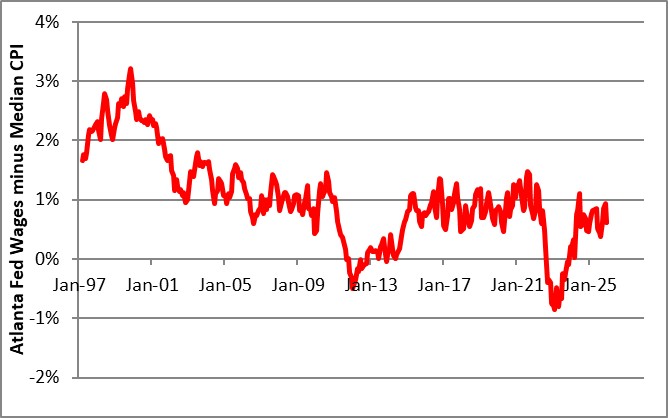
Psych! You fell victim to one of the classic blunders! This is again a y/y figure that is flattered by the lack of October data. On a m/m basis, supercore had the biggest jump in a year, +0.59% (SA). Still, I think this is decelerating along with median wages deceleration. Of course, all of that data is messy right now as well, but the spread of median wages over median inflation remains right around 1%.

There is some early evidence that the downward slide in wages might be leveling off; if it does, that will limit how fast supercore can moderate. There are also some cost pressures in insurance markets that are probably going to show up in the next 6 months or so. But that’s not January 2026’s story.
The story in January 2026 is that the waters remain muddied by the government-shutdown-induced gap. The current y/y figures are all flattered by that event, and exaggerate how good the inflation picture is. That’s how the Administration can trumpet victory while the reality on the ground is that inflation is not converging to trend.
I’m working on the assumption that the Fed knows this, and the combination of core inflation that seems steady around 3.5% (abstracting from the shutdown gap), better-than-expected labor market indicators, and a distinct animus among current Fed leadership towards the President means that there’s no reason to expect an adjustment in overnight rates any time soon. Frankly, I think the argument is better for a rate increase than a rate decrease. On the other hand, rents do appear to be continuing to decelerate even if we ignore the October gap. My model says that isn’t going to continue, and even if I’m wrong I’m likely to be closer than the folks calling for deflation in housing. And moderation in Supercore is encouraging, even if – again – I don’t think that continues to the point the Fed needs it to be. Core goods inflation appears to have peaked, and the question is whether we go back to core goods deflation or not.
In each of these cases, my modeling suggests that the current level of median inflation of around 3.5% (ex-gap) is likely to end up being an equilibrium-ish level. But it isn’t ridiculous to look at the current trends and see good news on inflation. Either way, there’s not a Fed ease coming imminently. But if those trends continue until Warsh is confirmed and becomes Fed Chairman, there could be a rate cut later in the year.
But that’s not January 2026’s story.
