


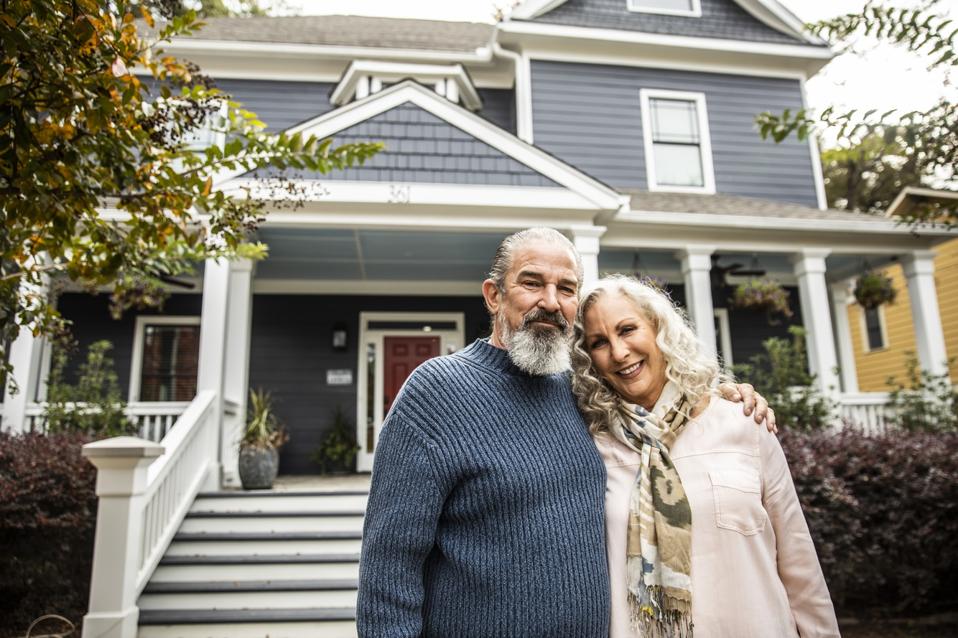
Portrait of senior husband and wife in front of suburban home
getty
A recent column in The Washington Post by housing finance expert Jim Parrott placed much of the blame for the current housing shortage on a tax that, he argued, discourages older adults from selling their homes.
I’m glad Parrott raised the important issue of seniors staying in their homes as they age. But his diagnosis is largely wrong. Tax law may play a small part in their unwillingness to move, but there are much bigger reasons that families, and policymakers, need to confront.
More important than taxes: The absence of affordable, accessible, and attractive housing; very low mortgage rates on their current homes; emotional ties to homes and communities; the physical challenges of moving; and the desire to bequeath a home to their heirs are just some. I suspect taxes are among the last things on their minds.
Capital Gains Taxes
Parrott, a fellow non-resident fellow at The Urban Institute and a former senior housing official in the Obama administration, identified the problem as the capital gains tax home sellers must pay once their sales profit exceeds $250,000 for singles and $500,000 for joint filers.
He argued that since the tax trigger was set in 1997, Congress should double the exemption on tax-free sales by older adults to reflect increases in house prices.
Several bills in Congress would broaden the exemption. President Trump has proposed eliminating the tax on home sales entirely.
True, the tax may discourage some sales by some homeowners. But doubling the tax exclusion won’t encourage many seniors to sell.
Few Pay The Tax
The median sales price of a home in the US last year was about $369,000, according to the data firm ATTOM. But that was the sales price, not the profit. The median return on a sale was only about $123,000, far below the amount that would trigger capital gains taxes for even a single filer.
The Yale Budget Lab estimates only about 10 percent of home sellers of all ages had capital gains on sales of their primary residences above the current exclusion amount. It estimated that, in 2022, those sellers had an average net worth of $5.7 million
They’d likely include older adults have held on to their homes for many years in communities where housing values boomed.
But high net-worth, high-income home sellers already have ways to avoid the levy. They could, for example, harvest losses from securities or other investments to reduce or eliminate any capital gains tax they owe on their home sales. Under some circumstances, widows or widowers may be able to take advantage of the $500,000 exclusion normally available to couples.
In addition, houses subject to the tax are likely to be extremely expensive. And it is hard to see how encouraging their owners to sell will address the housing shortage for low- and middle-income households.
Why Won’t Seniors Move
Focusing on taxes ignores more significant, and complex, reasons why older adults won’t leave their homes.
For many, it is lack of an appropriate replacement. For example, developers build apartments that Gen Z may love but are too small for seniors downsizing from a single-family home. For example, the average size of one-bedroom apartment was about 900 square feet last year. Other estimates are even smaller.
In addition, few homes have the amenities older adults need, such as universal design kitchens, no-threshold showers, and the like. Why, an older adult may ask, should I pay more for a smaller home that does not even fit my needs?
High quality senior communities can address many of these issues. But for many middle-income seniors, they are unaffordable. And some older adults much prefer staying in multi-generational neighborhoods.
Then, there are the challenges of moving such as deciding what to take and the daunting tasks of packing. Moving is hard for older adults.
Community Connections
The biggest impediments of all, however, may be emotional. People are attached to homes where they may have raised their children or lived with a beloved spouse who passed away. Those memories are tough to leave.
Similarly, there are connections to community. Leaving neighbors, friends, fellow congregants in faith communities, members of the bridge club, or even a favorite local restaurant, is not easy. In addition, many older adults equate leaving a home with losing independence.
Then, there is the desire to leave a home for children. In reality, the kids probably don’t want it. But try to tell parents that.
I often talk to older adults about these issues (and, full disclosure, I serve on the board of a non-profit continuing care retirement community). I tell attendees at my talks that the biggest mistake many seniors make is waiting too long to move. If they wait for a medical crisis, their choices will be severely limited.
It also is true that delivering medical and long-term care to older adults scattered throughout suburbs is extremely inefficient and expensive, especially at a time of severe shortage of care workers.
Bottom line: Parrott is partly right. We need to find better ways to encourage older adults to move from their long-time homes. But cutting the taxes of a handful of high net-worth seniors won’t solve the problem.
