


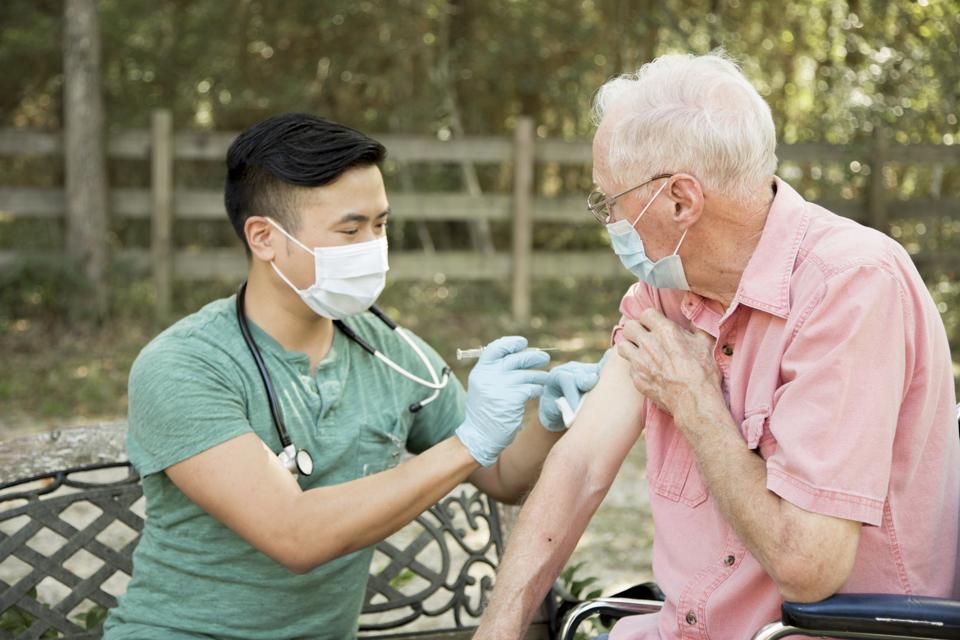
Senior adult receives injection from his home health care nurse.
getty
The latest vaccine recommendations by a federal Centers for Disease Control advisory panel could put older adults at risk for severe illness. Not directly, perhaps, but due to growing uncertainty over the risks and benefits of vaccines.
In addition, the changes may end up costing the government, through Medicare and Medicaid, as well as private insurance, billions of dollars—costs that likely will be passed on to consumers through higher premiums.
The recently updated recommendations by the Centers for Disease Control’s Advisory Committee on Immunization Practices (ACIP) were both highly controversial and confusing. The panel’s members were appointed by Department of Health and Human Services Secretary Robert F Kennedy Jr. after he fired all its previous members. The new committee approved the recommendations at a meeting on Sept 18-19.
Chaos and Confusion
“Ultimately, what this meeting presented was a sense of chaos, and a sense of lack of confidence in access to vaccines that are safe and prevent disease for the American public,” said Helen Chu, MD, an infectious disease physician and professor of medicine at the University of Washington School of Medicine. Chu was formerly a member of the panel.
The other day, I encountered a first-hand example of how the confusing new rules create uncertainty for older adults. A 67-year-old woman told me her doctor recommended she get both a seasonal flu shot and the standard vaccine against pneumonia.
In the past, these jabs would have been non-controversial. But after hearing about the CDC panel’s concerns about vaccines, she was skeptical about getting the pneumonia shots. “I don’t want it to make me sick,” she told me.
Pneumococcal pneumonia can be deadly for older adults and young children. The risks of the vaccine to most older adults are very low, usually limited to soreness at the injection site and sometimes fever or chills for a day or so.
For certain pneumonia shots, along with several other vaccines including COVID-19, the panel recommended expanding a process called “shared clinical decision-making.” In other words, before receiving certain vaccines, patients should first consult with a health care provider, such as a physician, physician assistant, nurse practitioner, registered nurse, or pharmacist.
Variation Among States
To add to the confusion, vaccine rules vary widely among states. Some, such as Pennsylvania, are explicitly encouraging the use of COVID-19 and other vaccines while others, such as Florida, are discouraging them. In a recent tweet, the Florida surgeon general called COVID-19 vaccines “unsafe and not fit for human use.”
The research non-profit KFF reports that 22 states are now relying on non-federal vaccine guidelines from organizations such as medical societies or creating their own multi-state advisory groups to replace or supplement the CDC and ACIP.
The Price Of Shared Decision-Making
Shared decision-making is not new. And, of course, some people should consult their physician before getting a shot, especially if they have had adverse reactions in the past.
But there are two potential problems with the growing, widespread use of this practice. First, out of either an abundance of caution or the opportunity to collect additional payments, some medical practices may require an office visit before approving a vaccine. That will cost government or private insurance, which are required to pay for visits covered by CDC recommendations.
Some rough numbers: Traditional Medicare pays about $90 for a routine 10-minute office visit. The visit already should be covered for Medicare Advantage patients. But let’s say half of the 36 million traditional Medicare enrollees need a visit to get their doctor’s OK for vaccinations. That’s an additional, largely unnecessary, cost to Medicare of roughly $1.5 billion annually. President Trump’s DOGE team might even call it waste.
And at a time when the nation is facing severe shortages of primary care physicians, time spent consulting on vaccines where there is little or no risk to most patients will only add to the burden on overtaxed medical practices and increase waiting times for patients with true medical needs.
In addition, many consumers don’t have a regular doctor, may be reluctant to visit one, or are uninsured. A pharmacist may sign off, but in states such as Florida that frown on vaccines, they may be unwilling.
At the very least, this requirement is likely to result in more paperwork both for patients and pharmacists. Requiring more healthcare paperwork seems to be a growing trend among Republicans.
Discouraging Older Adults
The second problem was personified by the older woman I spoke with. The ACIP guidelines are highly technical and difficult for most Americans to understand. Many are likely to have only half-heard the stories about the new guidelines. And the general anti-vax tone of the ACIP discussion and recommendations along with President Trump’s follow-up press conference (watch at about 85 minutes of this event) may signal to many that all vaccines are risky for all populations.
More than eight-in-tend COVID-19 deaths were people age 65 and older. And at a time when fewer than one-quarter of adults are getting COVID-19 shots, fewer than half are getting flu vaccines, and only about half of older adults are getting anti-pneumonia injections, warnings about the dangers of vaccines from senior government officials are likely to lower those rates even more. This inevitably will lead to more unnecessary sickness and death among older adults
