


Individual investors are always looking for hints as to where stocks are heading next. Some use fundamental analysis to look for strong earnings growth, reasonable valuations, and manageable debt loads. Others use technical analysis to spot trend reversals or gauge the strength of momentum in a particular security.
However, it’s difficult for individual investors to perform fundamental and technical due diligence on an entire portfolio of stocks, let alone entire sectors or markets. Institutional investors, on the other hand, have vast resources for market research and the expertise to separate the signals from the noise.
That’s why many investors consider institutional buying and selling to be another form of research itself, as institutions are often ahead of analysts, financial media, and retail investors.
Recently, institutional investors have been eyeing a couple of particular finance stocks, which is notable considering the expected interest rate reductions coming later this year. Should you follow the “smart money” into these companies as well?
Institutional Investors Are Often Ahead of the Market Curve
If you can’t beat ‘em, join ‘em. It worked for Kevin Durant with the Golden State Warriors, and it can also work with retail investors and institutions. Now, you likely won’t be able to access their research, but you can track their positions and follow their lead when it comes to buying and selling stocks.
Institutional investors include hedge, mutual, pension, and other asset managers. These companies hire the best and brightest stock investors and provide them with sophisticated analysis tools and substantial capital to manage.
Because of these factors, institutions are viewed as the “smart money,” and when institutional money flows into a stock, it’s often a bullish signal for retail investors.
Institutional investment is a slow process. Unlike retail investors, institutional investors are not looking to profit from short-term price fluctuations by buying 100 shares. These companies often invest through large block trades and scale into positions over a period of weeks or months.
Scaling into large positions can be tedious, but it also pumps substantial liquidity into the market of a particular security. That’s why retail investors often play ‘follow the leader’ with institutions; not only do they use the most sophisticated and complete research methods, but they also provide price stability by injecting huge sums of capital into a stock’s float.
Institutional investors can and do make mistakes, so tracking ‘smart money’ ownership isn’t an infallible strategy. However, when institutional ownership increases across the board, shrewd investors take notice.
Institutions Are Buying These Financial Stocks
Other than tech, the financial sector has been one of 2025’s biggest winners. However, the high-interest-rate environment is expected to end this year as the Federal Reserve begins easing. Why would institutions buy financial stocks with interest rate headwinds on the horizon?
These companies can navigate rate reductions without serious hits to their profits.
Charles Schwab: A Bet on Size and Stability
At this juncture, an investment in The Charles Schwab Corp. (NYSE: SCHW) is a bet that the firm’s asset management and trading desks will make up for any lost interest income from rate reductions.
Schwab has a massive client base, topping 37 million following the TD Ameritrade acquisition, and total client assets total well over $10 trillion.
The firm posted strong earnings numbers in Q1 and Q2 this year, and institutional buying is starting to pick up.
Institutions have bought more than $22.7 billion in SCHW shares over the last 12 months, compared to outflows of $12 billion. This buying frenzy has picked up substantially over the previous three quarters, including inflows of $8.7 billion in Q1.
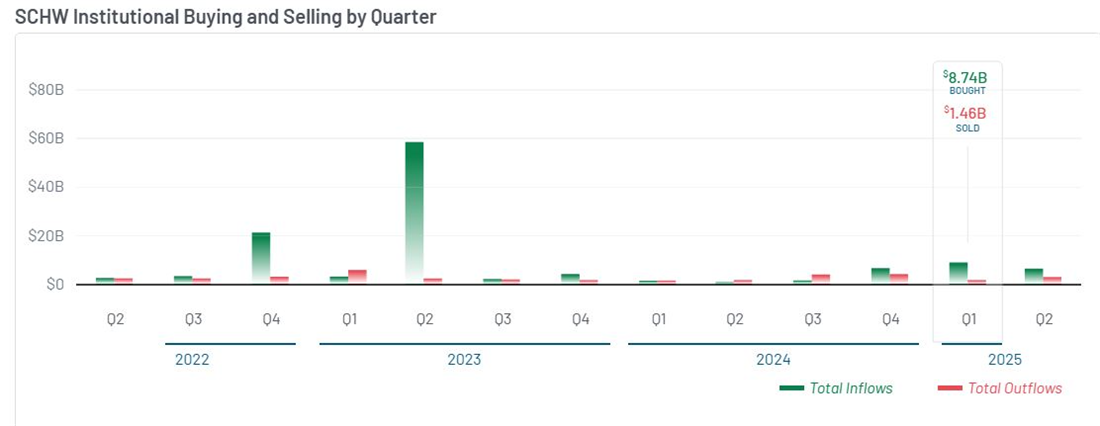
Institutional investors are wagering that Schwab’s business model can withstand lower interest margins through trading and asset management fees boosts.
KKR: Public Exposure to Private Markets
KKR and Co. Inc. (NYSE: KKR) specializes in alternative asset management and was a major player in the 1980s leveraged buyout craze. The company’s focus is more diversified through private equity, private credit, real estate, and insurance.
However, its focus on private markets has intrigued institutional investors, thanks to soft markets in IPOs and M&A.
KKR has positioned itself as a leader in the private credit markets, providing liquidity to companies and investments that can’t access funding from traditional banks.
KKR recently raised more than $6.5 billion for a new private credit fund using an “asset-based finance” strategy, and continues to provide access to private markets for qualified investors through its hybrid private/public funds.
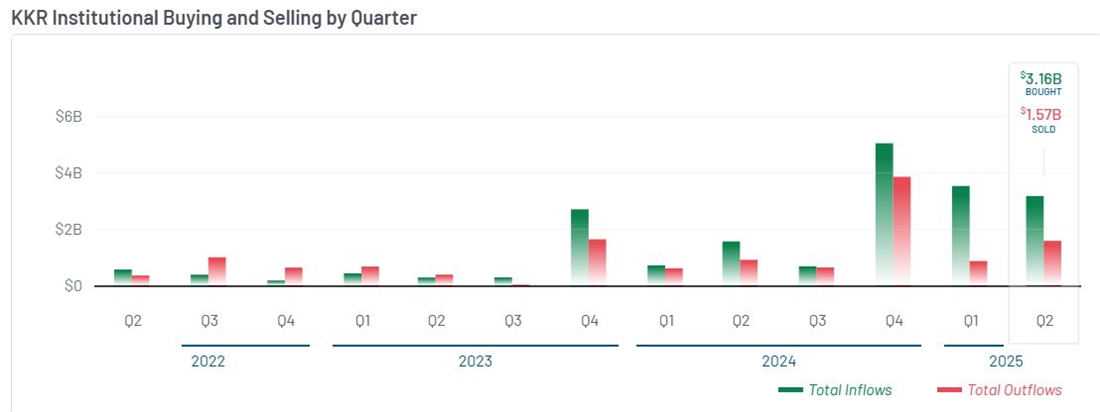
Private market returns are often uncorrelated to public markets, offering a hedge against traditional stock investments. Institutions are embracing this value proposition, as over $12 billion in institutional capital has flowed into KKR shares over the last 12 months, including $11 billion in the previous three quarters alone (versus $6.3 billion in outflows). In fact, institutions have put more capital in KKR in the last three quarters than in the previous three years combined; now that’s a bullish signal.
Before you make your next trade, you’ll want to hear this.
MarketBeat keeps track of Wall Street’s top-rated and best performing research analysts and the stocks they recommend to their clients on a daily basis.
Our team has identified the five stocks that top analysts are quietly whispering to their clients to buy now before the broader market catches on… and none of the big name stocks were on the list.
They believe these five stocks are the five best companies for investors to buy now…
The views and opinions expressed herein are the views and opinions of the author and do not necessarily reflect those of Nasdaq, Inc.
